Disclosure: this article contains affiliate links. If you buy through them, we may earn a commission at no extra cost to you. How this works.
Short answer
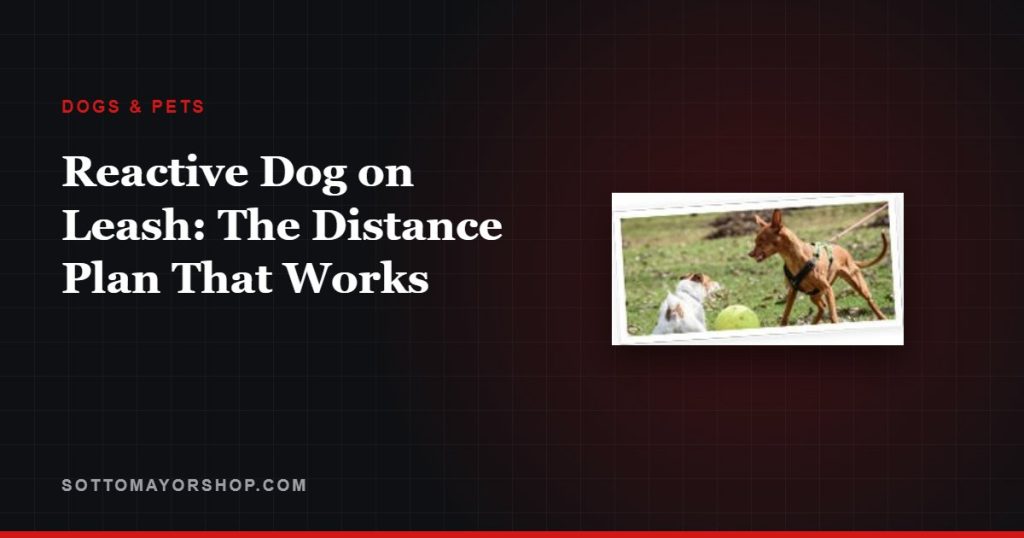
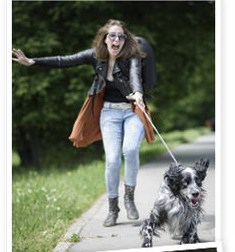
A reactive dog on leash is not being disobedient. Barking and lunging at another dog is a distance-increasing display from an animal that feels trapped on a six-foot rope with nowhere to go.
The plan is always the same: find the distance where your dog can still eat, pay every calm look at the trigger, and close the gap by feet over weeks — never by dragging the dog closer.
Force-free training that goes at your dog’s pace
- Created by Adrienne Farricelli, a CPDT-KA certified trainer
- 21+ force-free games in graded modules, with video demonstrations
- An archive of solutions for barking, chewing, jumping, digging and more
- Instant access and a 60-day money-back guarantee
What reactivity actually is
Off leash, a worried dog does what dogs do: arcs around, looks away, increases distance. On leash it can do none of that, so it uses the only tool left — noise and size — to make the scary thing go away.
And it works. The other dog always does eventually pass, which means the display gets rehearsed and reinforced several times a week.
That is why reactivity rarely fades on its own, and why the fix has to give the dog a different way to create distance.
Find the threshold before anything else
Every session starts by finding this distance again, because it changes with the day, the trigger and how the week has gone.
| What you see | Where you are | What to do |
|---|---|---|
| Sees the dog, looks back at you, eats | Under threshold | This is your working distance |
| Stares, stiff, still eats slowly | At the edge | Add ten feet |
| Will not take food, fixed stare | Over threshold | Leave, and add a lot of distance |
| Barking, lunging, spinning | Well over | Get out. Nothing is being learned here |
The core exercise
This pattern — see the thing, get paid — changes what the trigger predicts. Over weeks, another dog stops meaning danger and starts meaning chicken.
- Stand where your dog notices the trigger but stays loose.
- The moment your dog looks at the other dog, mark — “yes” — and feed at your side.
- Repeat. You are paying the look, not a sit, not eye contact with you.
- Within a few reps most dogs start looking at the trigger and then turning to you on their own. That turn is the behaviour you want.
- End the session while it is still going well, and leave before the trigger gets closer.
The emergency exits
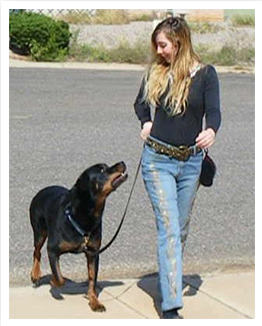
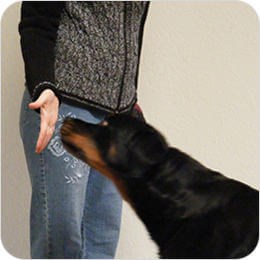
You need two behaviours that work when a dog appears around a corner at ten feet. A hand target — touch my palm — turns the head and moves the body without a fight over the collar. And a cheerful “let’s go” that means turn and walk the other way, taught first in the hallway with no trigger at all.
Practise both on quiet streets until they are boring. A cue you have only ever used in a crisis will fail in a crisis.
Scatter feeding also buys you seconds: a handful of treats tossed in the grass puts the dog’s nose down and the head away from the trigger while it passes.
Manage while you train
Every reaction the dog rehearses sets the work back. For the first weeks, walk at hours when the street is empty, cross early, use car parks and quiet industrial roads, and accept that the busy park is off the schedule for a while.
Equipment matters here. A well-fitted harness with a front clip gives you steering without adding pain, and a longer leash — eight to ten feet — lets the dog move away rather than being pinned at your knee.
Aversive tools work on the display and leave the fear underneath, which is how a barking dog becomes a silent dog that bites without warning. The professional bodies are clear on this, and so is the outcome.
Loose-leash mechanics make all of it easier: see the leash pulling plan for the walking underneath the training.
How long it takes
Weeks to months, honestly. Most owners see a first change within two to three weeks — the dog looks and turns back instead of exploding — and steady progress after that, with setbacks when something goes badly.
Setbacks are normal and not a restart. Drop back to a distance that works, do a few easy sessions, and carry on.
Progress is measured in feet and in recovery time: how close you can be, and how fast the dog settles after a surprise.
When to bring in a professional
Get help early if there has been a bite, if the dog redirects onto the leash or onto you, if the reactions are getting worse rather than better, or if you are dreading walks.
Look for a certified, force-free professional — CPDT-KA, KPA-CTP, IAABC or a veterinary behaviourist. And a vet visit first is not wasted: pain makes dogs reactive, and orthopaedic or dental pain is a common hidden cause.
A dog whose brain gets used at home copes better with the street, so keep the indoor games and a settle routine running alongside the outdoor work.
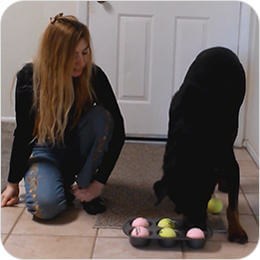
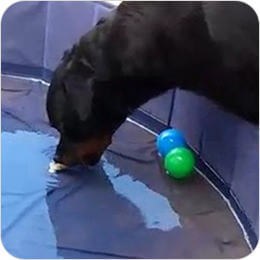
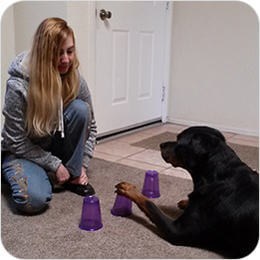
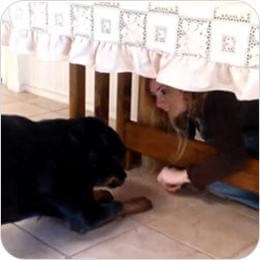
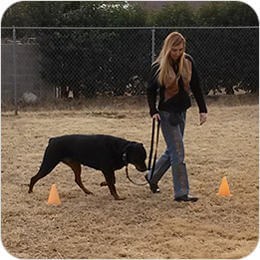
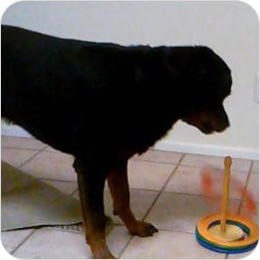
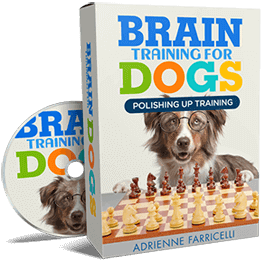
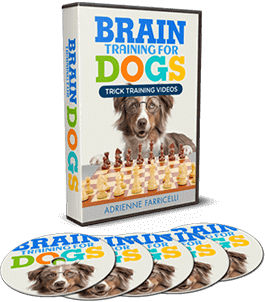
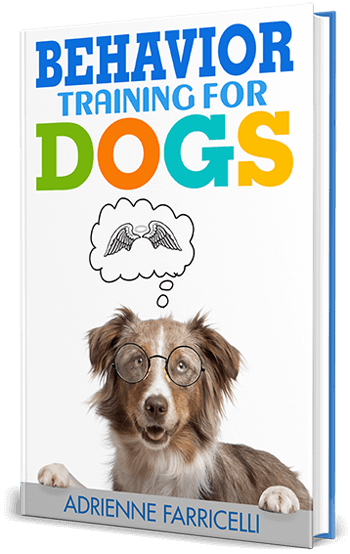
If you want those home sessions structured, Brain Training for Dogs gives you more than 21 games with step-by-step guides and video demonstrations, created by Adrienne Farricelli, a CPDT-KA certified trainer. Reactivity is on the list of problems the program covers.
A look inside Brain Training for Dogs





FAQ
Is my dog aggressive?
Most leash reactivity is fear or frustration, not aggression. The behaviour looks alarming because it is designed to. A qualified assessment tells you which you have.
Should I make my dog sit when another dog passes?
No. A sit takes away the dog’s ability to move and adds pressure. Keep moving, keep feeding, keep distance.
Am I rewarding the barking by feeding?
You are feeding the look, before the bark. If the dog is already barking you are over threshold, and the answer is distance, not food.
My dog is fine off leash. Why only on leash?
Because the leash removes the option to move away. That is the whole mechanism, and it is why longer leashes and wider arcs help so much.
Next step
Tomorrow, find the distance where your dog still takes food with another dog in sight. Work there for five minutes and go home. That distance is the whole programme. At home, keep the brain games going alongside it.
Based on standard force-free, positive-reinforcement practice for leash reactivity as taught by certified trainers, and on the widely published professional position against aversive equipment for fear-based behaviour. Product details for Brain Training for Dogs are from the vendor’s published page as of September 28, 2026.