
Disclosure: this article contains affiliate links. If you buy through them, we may earn a commission at no extra cost to you. How this works.
Short answer
A puppy crying at night is usually lonely, needs to pee, or is not yet used to sleeping alone. Put the crate right next to your bed, take the puppy out just before bedtime, handle night-time potty trips calmly and quietly, and most puppies settle within days.
The goal is a puppy that feels safe at night, not one left to cry it out in a far-off room.
A force-free program to start your puppy right
- Created by Adrienne Farricelli, a CPDT-KA certified trainer
- 21+ force-free games in graded modules, with video demonstrations
- An archive of solutions for barking, chewing, jumping, digging and more
- Instant access and a 60-day money-back guarantee
Why puppies cry at night
- Loneliness: until recently, the puppy slept in a warm pile of littermates.
- A full bladder: young puppies cannot hold it all night.
- A new place: new sounds, new smells, no routine yet.
- Too much or too little activity: an overtired or under-exercised puppy struggles to settle.
A bedtime routine that works
| When | What to do |
|---|---|
| Early evening | Play and a short training session, then quiet time |
| An hour before bed | Calm cuddles or a chew; no rough play |
| Right before bed | A last potty trip outside, praised quietly |
| Bedtime | Into the crate beside your bed, lights off, calm voice |
| Night | Quiet potty trips if needed, then straight back to bed |
Keep the crate by your bed
A puppy that can hear and smell you settles much faster. Put the crate right next to your bed for the first weeks; you can dangle fingers by the door if the puppy wakes. Something that smells of its old home or of you in the crate can help too.
Once the puppy sleeps through reliably, you can move the crate a little at a time to where you want it long term. The crate itself should be a happy place by day — see crate training a dog for the week-by-week method.
Handling night-time potty trips
A common rule of thumb says a puppy can hold it for roughly its age in months plus one, in hours — so a two-month-old may need a trip outside in the night. When the puppy wakes and cries, carry or walk it outside calmly, wait for it to go, praise quietly, and put it straight back in the crate. No play, no lights, no excitement.
Daytime potty timing matters as much as night — the full schedule by age is in the puppy potty training schedule.
Telling need from protest
If the puppy has just been out and is warm, fed and safe, the crying is probably protest. Wait for a moment of quiet before you respond, so quiet — not crying — is what brings you. If it has been a few hours, assume it needs to go out.
Talk to your vet if the crying comes with vomiting, diarrhea, not eating, or signs of pain. Those are health questions, not training ones.
The first week sets the pattern
Night crying is part of settling in, and the whole first week matters: a quiet home, plenty of naps and a predictable routine. The day-by-day plan is in new puppy first week.
A puppy section that covers it
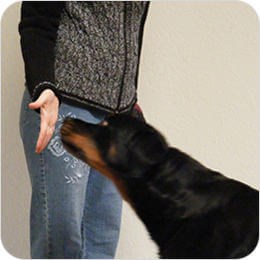
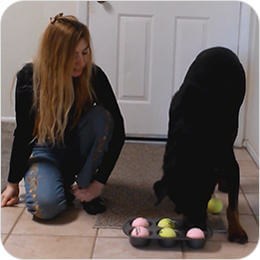
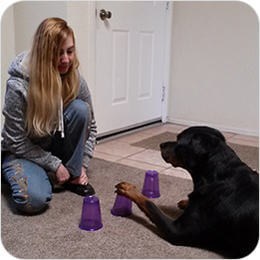
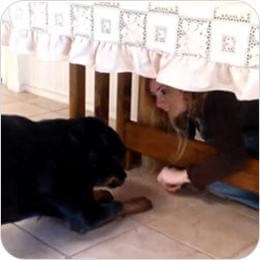
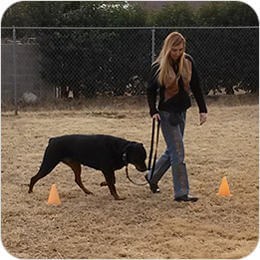
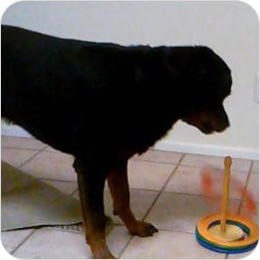
Brain Training for Dogs has an entire section on puppy training — potty training, crate training, socialization and bite inhibition — and covers whining that comes from attention-seeking, anxiety or excitement, alongside more than 21 brain games, created by CPDT-KA certified trainer Adrienne Farricelli.
A look inside Brain Training for Dogs

















FAQ
How long will my puppy cry at night?
Many puppies settle within a few nights to a week when the crate is by the bed and the routine is consistent.
Should I let my puppy cry it out?
Leaving a young puppy to cry alone in a far room tends to make nights harder. Keep the crate close and respond calmly.
Should I take my puppy out at night?
Yes, young puppies usually need a night-time potty trip. Keep it calm and boring, then straight back to bed.
Where should a puppy sleep the first night?
In a crate next to your bed, where it can hear and smell you.
Next step
Tonight, move the crate beside your bed and take the puppy out right before lights-out.
Based on standard puppy-raising practice from force-free trainers: crate placement, bedtime routines and night-time potty breaks. Product details for Brain Training for Dogs are from the vendor’s published page as of September 29, 2026.