Disclosure: this article contains affiliate links. If you buy through them, we may earn a commission at no extra cost to you. How this works.
Short answer
Dog mental stimulation does in ten minutes what a half-hour walk often cannot: it uses the nose and the problem-solving drive, and a dog that has worked those settles on his own.
Seven games below, all playable indoors with things you already own. Play one or two a day, keep the sessions short, and end while your dog still wants more.
21+ brain games, organized from easy to advanced
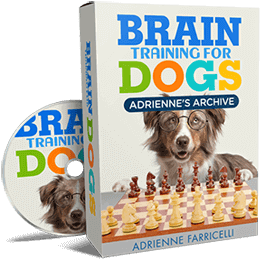
- Created by Adrienne Farricelli, a CPDT-KA certified trainer
- 21+ force-free games in graded modules, with video demonstrations
- An archive of solutions for barking, chewing, jumping, digging and more
- Instant access and a 60-day money-back guarantee
The rule that makes every game work
Mark the moment the dog gets it right, then deliver the treat. A word (“yes”) or a click, at the instant of the behavior, and the food a second later. Reward late and you pay for whatever the dog did next, which is usually looking at your hand.
Keep sessions to five or ten minutes and stop on a win. Two short sessions beat one long one, and a dog that ends wanting more starts faster tomorrow.
Seven games, and what each one builds
| Game | How it works | What it builds |
|---|---|---|
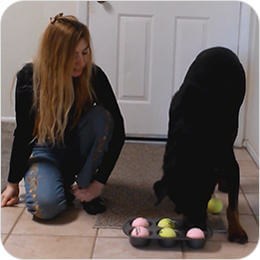
| Muffin tin | Treats in a muffin tin, tennis balls on top | Problem-solving, persistence |
| Find it | Toss a treat, let the dog use his nose to locate it | Scent work, calm arousal |
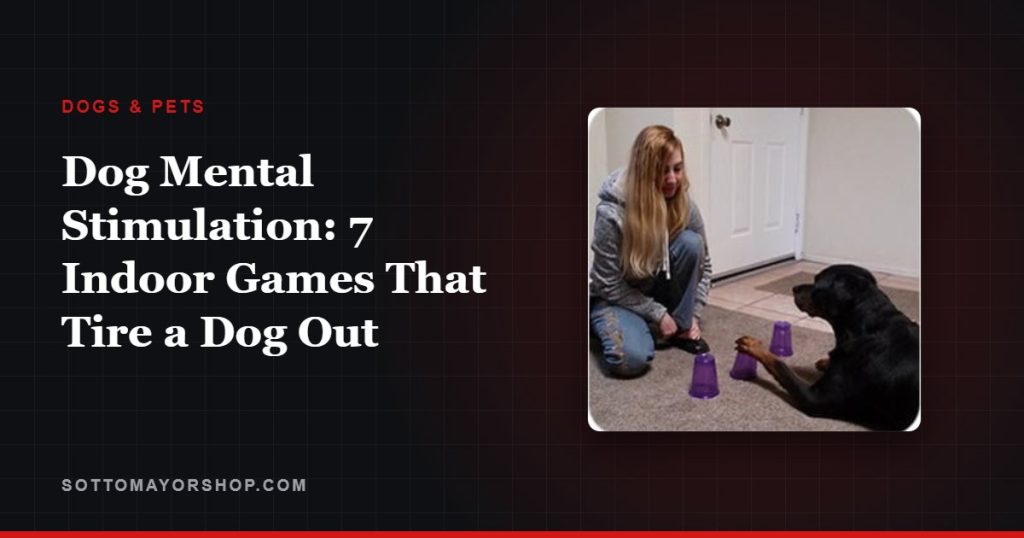
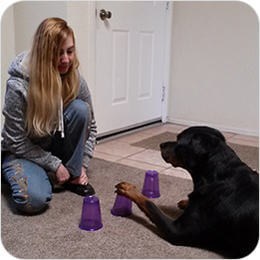
| Three cups | One treat, three cups, let the dog choose | Focus, impulse control |
| Towel roll | Roll treats inside a towel, let him unroll it | Nose work, frustration tolerance |
| Name the toy | Hold up one toy, name it, reward the touch | Vocabulary, targeting |
| Hide and seek | You hide in the house, call once, reward the find | Recall, confidence |
| Place and wait | Send him to a mat, build up the seconds before the release | Settling, patience |
Start with the nose
Scenting is the cheapest calm you can buy. Scatter a handful of kibble on a towel or across a rug and let the dog work it out. Sniffing lowers arousal, which is why it is the best game right before something stressful — a visitor, a vet trip, a thunderstorm.
It is also self-scaling: as the dog gets faster, you hide the food in harder places without changing the rules.
Then build the impulse control
Three cups and place-and-wait are where the manners come from. The dog learns that offering patience produces the reward, and that transfers straight to the front door, the food bowl and the leash.
Build the wait in seconds, not minutes. Three seconds today, five tomorrow, and release with a word before the dog breaks on his own.
This is the same skill that ends door-bolting and half of leash pulling — see the leash plan for the outdoor half.
Common mistakes
Three things account for most of the frustration in these sessions, and all three are easy to correct.
- Sessions too long: the dog disengages and you end on a failure.
- Treats too big: use pea-sized pieces so you get twenty repetitions instead of five.
- Helping too early: let the dog work the puzzle for a few seconds before you step in, because the working is the point.
When you want the graded version
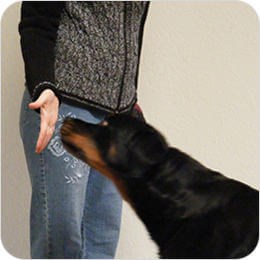
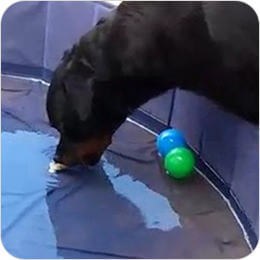
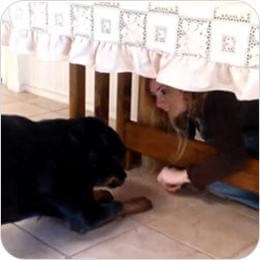
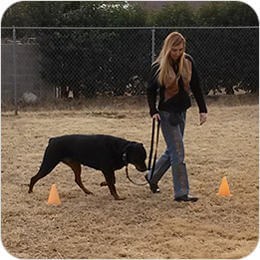
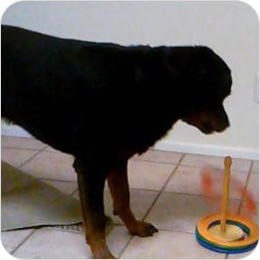
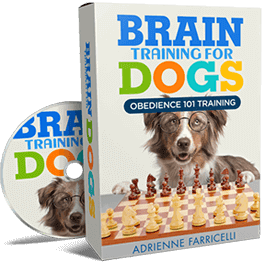
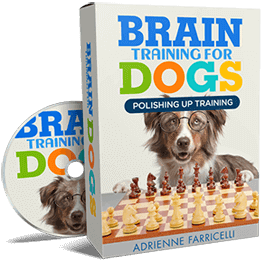
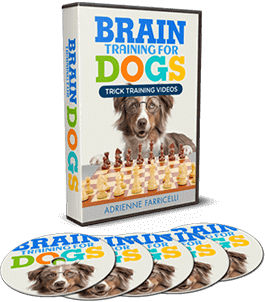
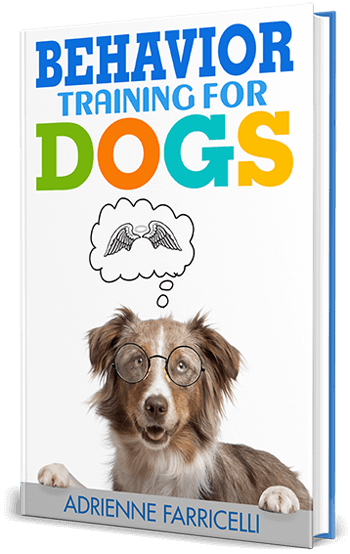
These seven are a starting kit. If you would rather follow a curriculum that moves from focus games to multi-step puzzles, with video demonstrations and a troubleshooting section for each one, that is what the Brain Training for Dogs program organizes into modules.
It has more than 21 games, each with step-by-step guides and video demonstrations, created by CPDT-KA certified trainer Adrienne Farricelli. See the full program here.
A look inside Brain Training for Dogs
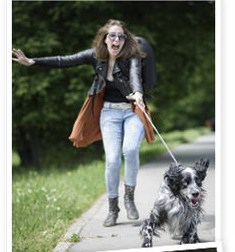

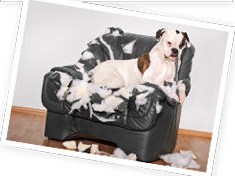

FAQ
How much mental stimulation does a dog need?
Ten to twenty minutes a day, split into short sessions, changes behavior in most pet dogs. Working breeds usually want more.
Can puzzle toys replace the games?
They help, but a toy the dog solves alone stops being interesting fast. Games you run together also build the relationship and the cues.
My dog gives up quickly. What do I do?
Make the first repetition obvious — treat in plain sight — and increase difficulty only after three easy wins in a row.
Is it better before or after a walk?
Before, if your dog leaves the house over-excited. After, if he comes home wired and cannot settle.
Next step
Pick two games from the table and run them tonight, five minutes each, before dinner. Note which one your dog stays with longest — that is the one to build on. When you are ready for more than seven, the full program has over 21.
Based on standard force-free, positive-reinforcement training practice as taught by certified trainers. Product details for Brain Training for Dogs are from the vendor’s published page as of September 28, 2026.