
Disclosure: this article contains affiliate links. If you buy through them, we may earn a commission at no extra cost to you. How this works.
Short answer
Puppy potty training is a schedule problem before it is a training problem. Take the puppy out before he needs to ask, pay him outside within three seconds, and never let him practice indoors.
The rule of thumb for bladder capacity is his age in months plus one, in hours — an eight-week puppy needs a trip roughly every two hours, and after every meal, nap and play session.
A force-free program to start your puppy right
- Created by Adrienne Farricelli, a CPDT-KA certified trainer
- 21+ force-free games in graded modules, with video demonstrations
- An archive of solutions for barking, chewing, jumping, digging and more
- Instant access and a 60-day money-back guarantee
The four moments that always need a trip
Hit those four and the schedule below almost runs itself. Miss them and no amount of training makes up for it.
- Waking up, from the night or from any nap. Carry a small puppy outside; walking wakes the bladder.
- After eating or drinking, within 10 to 20 minutes.
- After play, because excitement empties bladders.
- Before you leave the room or put him in the crate.
The schedule by age
| Age | Daytime interval | Night | What changes |
|---|---|---|---|
| 8–10 weeks | Every 1–2 hours | One or two trips | Carry him out; use one spot in the yard |
| 10–12 weeks | Every 2 hours | Usually one trip | Start the cue word as he goes |
| 3–4 months | Every 3 hours | Often sleeps through | Add a signal: bell, sit at the door |
| 4–6 months | Every 4 hours | Sleeps through | Start extending time indoors, supervised |
| 6+ months | Every 4–6 hours | Sleeps through | Accidents now mean a schedule or health issue |
What to do outside
Go to the same spot every time, stand still and stay boring. A puppy who gets a walk immediately learns that going is what ends the fun outside.
The instant he finishes, mark it — “yes” — and give two or three small treats right there. Three seconds late and you are paying for whatever he did next, which is usually sniffing.
Add the cue word only once the pattern is reliable: say it quietly while he is going, and within a couple of weeks it starts working as a request.
What to do indoors
Supervision or containment, with nothing in between. Puppy on a leash attached to you, in a pen, or in a crate — a loose puppy in a quiet room is a puddle waiting to happen.
The crate helps here because most dogs will not soil where they sleep, as long as the space is only big enough to stand, turn and lie down. Our seven-day crate plan builds that without the crying.
Set a timer on your phone for the interval in the table. Waiting for the puppy to signal is how weeks get lost.
Accidents
- Interrupt calmly if you catch him in the act — a soft sound, then straight outside. No shouting, no rubbing his nose in it.
- Clean with an enzymatic cleaner, never with ammonia-based products, which smell like urine to a dog and invite a repeat.
- If you find it after the fact, clean it and change the schedule. Punishment after the event teaches the puppy to hide where he goes, which is worse.
- Three accidents in the same room means that room is off limits for a couple of weeks.
Night-time
Last water about an hour before bed, last trip right before lights out, and the crate next to your bed so you hear him. At eight to ten weeks, expect one or two wake-ups.
Make the night trip boring: no lights, no talking, out and straight back. Any fun and the 3 am trip becomes a habit rather than a need.
Most puppies sleep through by twelve to sixteen weeks, and a puppy who already slept through and starts waking again is worth a vet check for a urinary infection.
When it stalls
Two causes cover almost every stalled case: the schedule slipped, or the puppy is being rewarded indoors by accident — a puddle that got attention, a rug that smells like the last accident.
Go back to the interval for the age below his, clean every previous spot with enzyme cleaner, and restart. Most owners see it click again within a week.
And if the puppy is fine with the schedule but wild in the evenings, the answer is usually mental work rather than more walks — start with the indoor games.
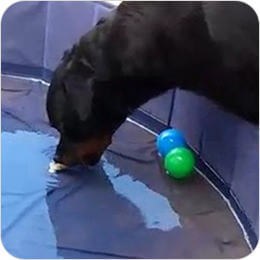
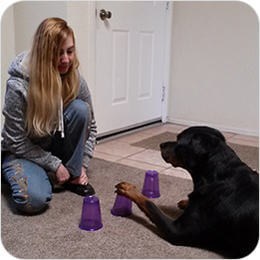
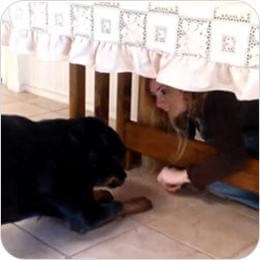
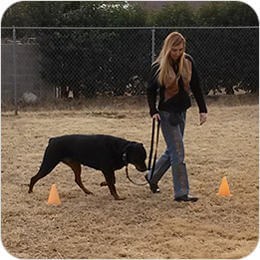
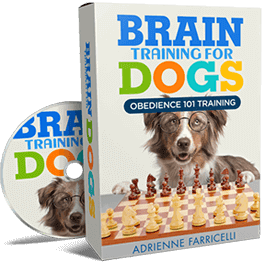
For the full puppy routine in one place, Brain Training for Dogs has an entire section on puppy training — potty training, crate training, socialization and bite inhibition — plus more than 21 brain games for the wild evenings.
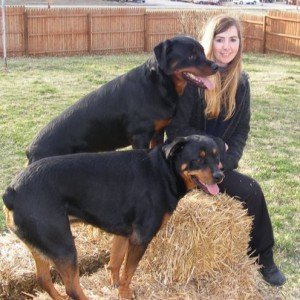
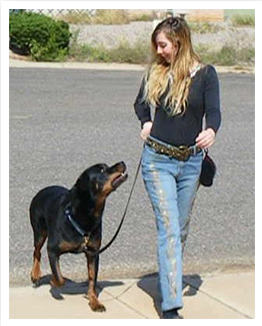
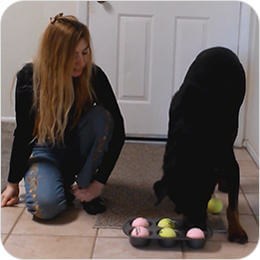
A look inside Brain Training for Dogs





FAQ
How long does potty training take?
Most puppies are reliable indoors by four to six months with a consistent schedule; full reliability in new places takes longer.
Should I use pee pads?
They help in apartments and high-rise buildings, but they also teach that going indoors is allowed. If you can get outside, skip them.
My puppy goes right after coming back inside.
He was distracted outside. Stay longer, stand still, and wait for the second go before you head back in.
Is a bell on the door a good idea?
Yes, once the schedule works. Ring it yourself each time you open the door and the puppy will start ringing it himself.
Next step
Write the interval for your puppy’s age on a sticky note by the door tonight, and set the phone timer. The schedule does most of the work.
Based on standard force-free, positive-reinforcement training practice as taught by certified trainers. Product details for Brain Training for Dogs are from the vendor’s published page as of September 28, 2026.