Disclosure: this article contains affiliate links. If you buy through them, we may earn a commission at no extra cost to you. How this works.
Short answer
Resource guarding is a dog protecting something it values from being taken — food, a chew, a bed, sometimes a person. It is fear of losing, not a bid for status.
The fix is to change what your approach predicts. Right now it predicts loss. Every rep should make it predict something better arriving.
Force-free training that goes at your dog’s pace
- Created by Adrienne Farricelli, a CPDT-KA certified trainer
- 21+ force-free games in graded modules, with video demonstrations
- An archive of solutions for barking, chewing, jumping, digging and more
- Instant access and a 60-day money-back guarantee
Why taking things away makes it worse
The traditional advice — take the bowl away to show who is boss, put your hand in the food — does the opposite of what it claims. It confirms the dog’s prediction that people approaching valuable things means the thing disappears.
A dog that learns that gets more urgent about defending, not less, and it stops giving warnings, because the warnings got it told off.
Every modern protocol runs the other way: your approach becomes the best thing that happens while the dog has something good.
Read the early signals
Reading these in order is the whole safety margin — the same ladder covered in dog body language.
| Stage | What it looks like | What to do |
|---|---|---|
| Early | Eating faster, body curled over the item | Add distance, start the protocol |
| Clearer | Freezing, hard eye, head low over the item | Stop approaching. Manage. |
| Loud | Lip curl, growl, snarl | Back off. Do not punish the growl. |
| Contact | Snap or bite | Management only, and get professional help |
The trade-up protocol
The order matters. Approach predicts gain first; handling the item comes months later, if at all.
- Start with something the dog barely cares about, in a calm room.
- Stand at a distance where the dog keeps eating and stays loose. That distance is your starting line.
- Toss something better — chicken, cheese — toward the dog, then walk away. Do not approach further.
- Repeat until the dog looks up at you expectantly when you appear. That look is the behaviour you are building.
- Close the distance by a step at a time across sessions, never within one.
- Only much later, and only with low-value items, add picking the item up and giving it straight back with something better.
Teach a real swap
A dog needs a way to give things up that is not a fight. Teach it away from guarded items: offer a boring toy, present something better, say “drop”, pay, and hand the toy back. Ninety per cent of the time the dog gets the original item returned.
That last part is what keeps the cue working. If “drop” always means the fun ends, the dog stops playing along.
Practise until it works on things that do not matter. A cue you only use in emergencies fails in emergencies.
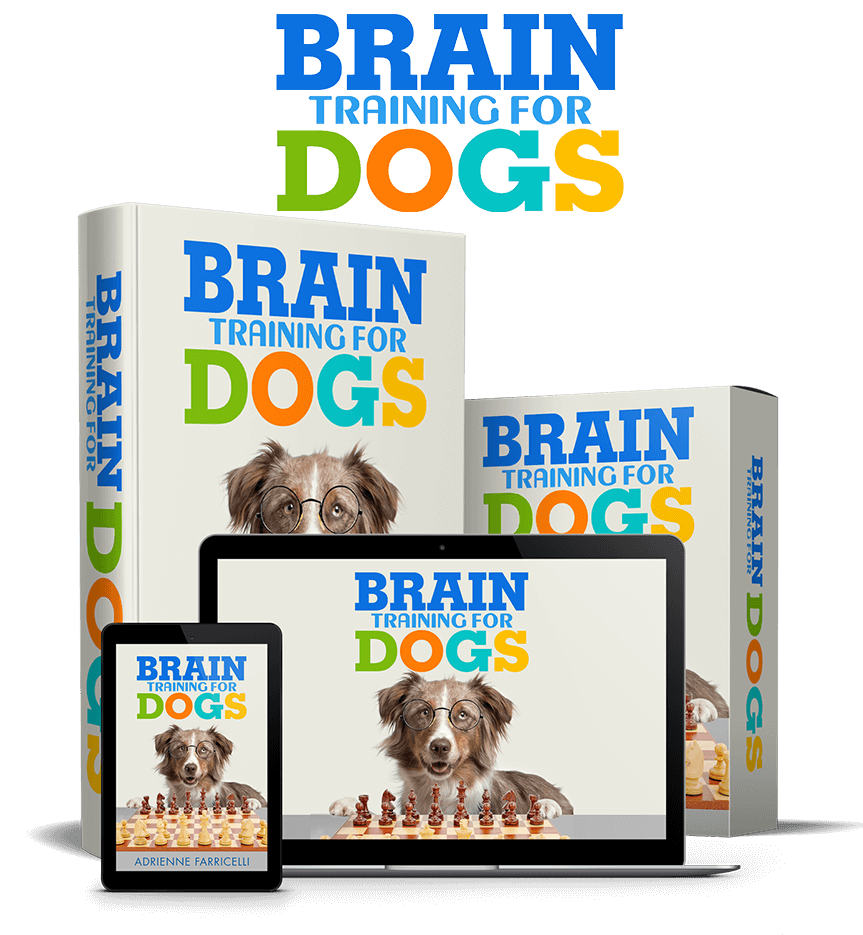
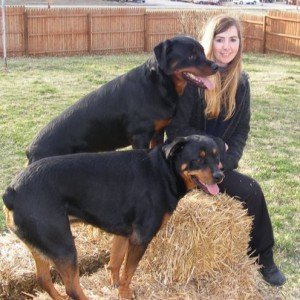
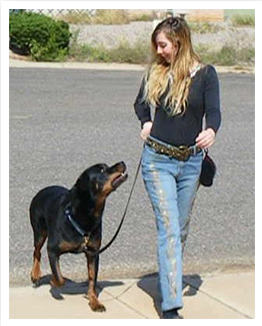
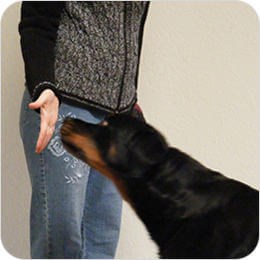
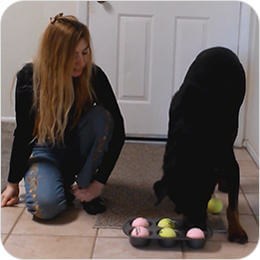
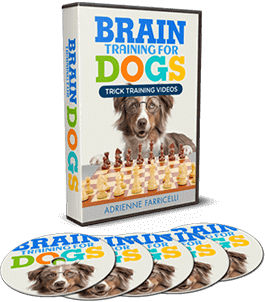
Short daily games make that kind of cooperation a habit. Brain Training for Dogs has more than 21 of them, each with step-by-step guides and video demonstrations, from CPDT-KA certified trainer Adrienne Farricelli.
Manage everything while you train
Feed in a quiet room with the door shut. Give high-value chews in a pen or crate, and collect them only once the dog has moved away. Pick up the things that trigger guarding when the dog is not there.
If the dog guards a bed or a sofa, make the spot less valuable rather than fighting over it: block access, or pay the dog for getting off with something better, every time.
Children and guarding dogs do not mix while the work is in progress. That is a supervision rule, not a training exercise.
Never reach into a growling dog’s space to prove a point. The bite that follows is entirely predictable, and it changes what happens to the dog afterwards.
Guarding people
A dog that stiffens when someone approaches you on the sofa is guarding you as a resource. The mechanics are the same: the approach of the other person should predict something good for the dog, delivered by you.
Have the other person walk past at a distance the dog tolerates while you feed. Shrink the distance across sessions.
In the meantime, keep the dog off laps and sofas where the guarding happens, and give it a mat of its own nearby — the routine in teaching a settle gives the dog somewhere to be that is not on top of you.
When to call someone
Get professional help immediately if there has been a bite, if a child lives in the house, if the guarding is escalating, or if the dog guards many different things.
Look for a certified, force-free professional — CPDT-KA, KPA-CTP, IAABC or a veterinary behaviourist. Guarding is one of the most treatable behaviour problems there is, and one of the easiest to make permanently worse with the wrong advice.
A vet check is also worth it. A dog in pain guards more, and sudden guarding in a dog that never did it is a medical question first.
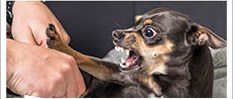
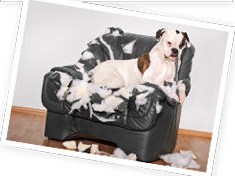
A look inside Brain Training for Dogs
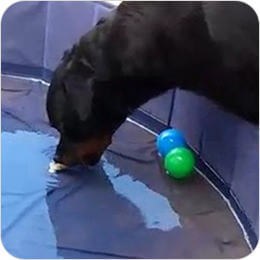
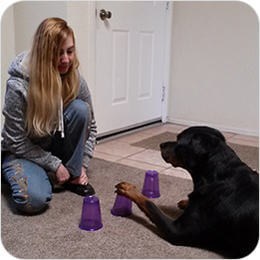
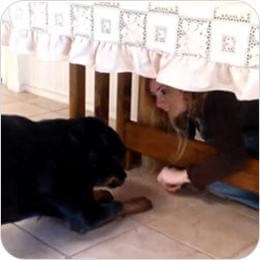
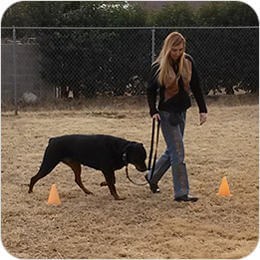
FAQ
Should I put my hand in my puppy’s food?
No. Drop something better into the bowl as you pass instead. The goal is for your hand near the bowl to predict an upgrade.
My dog growls over bones. Should I take them away?
Stop giving them unsupervised, and give them where you can collect them once the dog has left. Then work the trade-up protocol on lower-value items.
Is guarding a dominance problem?
No. It is about fear of losing something valuable, and it responds to changing that prediction rather than to confrontation.
Does it ever go away completely?
Many dogs get to a point where it no longer appears in daily life. Sensible management around very high-value items usually stays worth keeping.
Next step
This week, walk past your dog while it eats and toss something better into the bowl from a distance. Do it ten times, and do not approach any closer. Between those sessions, work the swap and the brain games away from anything the dog guards.
Based on standard force-free behaviour practice for resource guarding: counter-conditioning the approach, trade-based exchanges, and the professional consensus against confrontational methods. Product details for Brain Training for Dogs are from the vendor’s published page as of September 28, 2026.