Disclosure: this article contains affiliate links. If you buy through them, we may earn a commission at no extra cost to you. How this works.
Short answer
Dog body language runs as a ladder. Long before a growl there is a head turn, a lip lick, a yawn, a freeze — and most bites described as coming from nowhere were preceded by minutes of signals that nobody read.
Learn the bottom of the ladder and you rarely see the top of it.
Put what you read into training, step by step
- Created by Adrienne Farricelli, a CPDT-KA certified trainer
- 21+ force-free games in graded modules, with video demonstrations
- An archive of solutions for barking, chewing, jumping, digging and more
- Instant access and a 60-day money-back guarantee
The ladder, from quiet to loud
The practical lesson: never tell a dog off for growling. The growl is information, and it is the last thing standing between you and a bite.
| Stage | What it looks like | What the dog is saying |
|---|---|---|
| 1 | Head turn, look away, blinking, yawning | I am uncomfortable, please stop |
| 2 | Lip lick, turning the body away, sniffing the ground | I mean it, I am asking politely |
| 3 | Walking away, hiding, low body | I am leaving now |
| 4 | Freezing, whale eye, stiff still body | I cannot leave. This is the last quiet warning |
| 5 | Growl, snarl, air snap | Loud warning |
| 6 | Bite | The warnings did not work |
The signals people miss
- Lip lick with no food anywhere. One of the most common and most missed.
- Yawning when the dog is not tired — often during a hug or a vet exam.
- Whale eye: the whites showing in a crescent as the dog holds its head still and moves its eyes.
- The freeze. A dog that goes completely still over a bone or a bed is not relaxed; it is loading.
- Shaking off when dry, which usually marks the end of a stressful moment.
- Scratching or sniffing suddenly and out of context — a displacement behaviour, like checking your phone in an awkward conversation.
The tail is not a mood ring
A wagging tail means arousal, not friendliness. A high, fast, stiff wag over the back is a very different animal from a low, loose, whole-body wag.
Read the tail with the rest: a soft body, a curved spine and a loose open mouth say one thing; a high tail, a hard stare and a closed mouth say another, whatever the tail is doing.
Research on tail wagging has even found a side bias — more to the dog’s right in positive contexts, more to the left in negative ones — which is a good reminder that the wag alone tells you very little.
Loose versus stiff
If you learn only one distinction, make it this one. A comfortable dog is curvy: soft eyes, open relaxed mouth, weight evenly spread, tail moving loosely.
An uncomfortable dog is straight: tight mouth, hard eyes, weight shifted forward or back, body still. Stiffness is the single most reliable warning sign across every breed and every situation.
Everything else — ears, hackles, tail height — varies too much between breeds to read on its own. A pug’s face and a husky’s face say the same thing in very different shapes.
Where this matters most
Children and dogs. Most bites to children happen at home, with a familiar dog, during a hug or a lean. The dog almost always signalled first. Teach children to let the dog come to them, and supervise properly rather than trusting.
Greetings. A dog that turns its head away from a stranger’s hand is declining. Let it decline.
Resources. A freeze over food or a toy is a request for space, not a challenge to win.
The vet and the groomer. Handling practice at home, paired with food, is what makes these survivable — the routine covered in our puppy socialization checklist.
Use it as a threshold meter
Body language is also how you know whether training is working. A dog that will not take food, stares hard or goes stiff is over threshold, and nothing useful is being learned at that distance.
That is exactly the test in the leash reactivity plan: if the dog still eats and can look away, you are close enough and no closer.
The same reading tells you when a dog has had enough of a training session, a guest or a car ride — usually a few minutes before the behaviour falls apart.
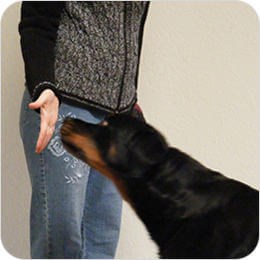
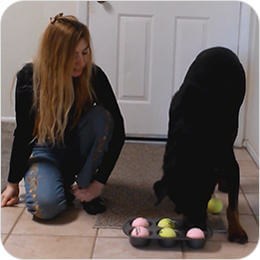
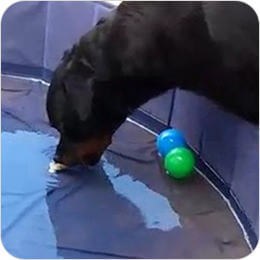
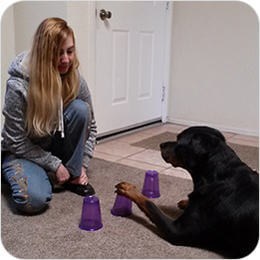
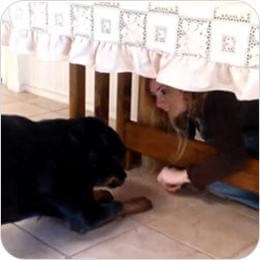
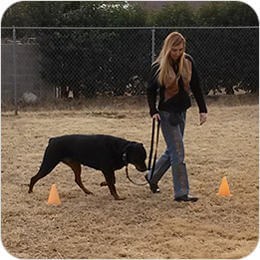
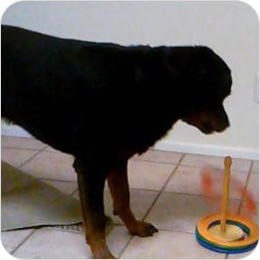
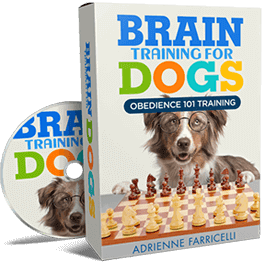
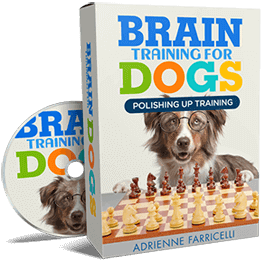
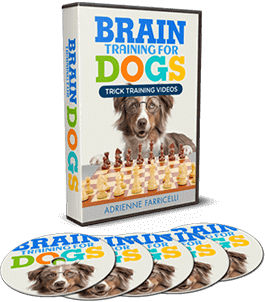
Short, structured sessions are the easiest place to practice that reading, because the dog is calm and you are watching closely. Brain Training for Dogs is built on exactly that: more than 21 games with step-by-step guides and video demonstrations, from CPDT-KA certified trainer Adrienne Farricelli.
Practise on video
Record thirty seconds of your own dog in an ordinary moment — a guest arriving, a nail trim, a toy being taken — and watch it back at half speed.
You will see signals you missed live, because they last a fraction of a second and you were busy managing the situation.
Do that a few times and the reading becomes automatic, which is the point. A dog whose quiet signals get answered stops needing the loud ones.
A look inside Brain Training for Dogs
FAQ
Should I punish growling?
Never. Growling is a warning that prevents bites. Punish it and the dog learns to skip straight to the bite.
What does yawning mean?
Usually stress, when the dog is not tired. It is one of the earliest and most commonly missed signals.
Are raised hackles a sign of aggression?
No. Hackles are arousal — excitement, fear or conflict. Read the body stiffness and the mouth instead.
My dog lets my child hug him. Is that fine?
Watch the video back. Most dogs tolerate hugs while signalling discomfort, and tolerance runs out. Teach the child other ways to interact.
Next step
Film thirty seconds of your dog during something ordinary tonight and watch it at half speed. Count the head turns, lip licks and yawns. Then put that reading to work in short daily games.
Based on standard canine body language material taught by certified trainers and behaviour professionals, including the widely used escalation ladder and published research on the tail-wag side bias. Product details for Brain Training for Dogs are from the vendor’s published page as of September 28, 2026.