Disclosure: this article contains affiliate links. If you buy through them, we may earn a commission at no extra cost to you. How this works.
Short answer
Puppy biting is normal, it peaks between eight and sixteen weeks, and it goes away faster when you teach the puppy to control his jaw pressure instead of trying to stop the mouthing entirely.
Three stages: no hard bites, then no teeth on skin at all, then a reliable redirect to a toy. Ten seconds of consequence, every time, and most puppies get there in two to three weeks.
A force-free program to start your puppy right
- Created by Adrienne Farricelli, a CPDT-KA certified trainer
- 21+ force-free games in graded modules, with video demonstrations
- An archive of solutions for barking, chewing, jumping, digging and more
- Instant access and a 60-day money-back guarantee
What the biting actually is
Puppies explore with their mouths and they play with their teeth, because that is what they did with their littermates. The littermates yelped and the game stopped — that feedback loop is how a dog learns how hard is too hard.
When the puppy comes home at eight weeks, that lesson is unfinished, and you become the littermate. The goal is not silence from the mouth; it is a dog who, years later, has a soft mouth even when startled.
This is why punishment backfires here. A puppy corrected for mouthing learns to avoid your hands, not to control pressure — and pressure is the part that matters.
Stage 1 — Kill the hard bites
The moment teeth close hard on skin, the game ends. A calm “nope”, hands go away, you stand up and stop interacting for ten to twenty seconds. No shouting, no scruffing, no holding the muzzle.
Then resume. The lesson is only learned through the contrast: hard bite ends the fun, soft mouth keeps it going.
Expect it to get slightly worse for a day or two before it improves, because the puppy tries harder at what used to work.
Stage 2 — Raise the standard
Once the hard bites are gone, apply the same consequence to medium pressure, then to any teeth on skin at all. Move up only when the current level has been quiet for a couple of days.
By the end of this stage, the puppy should be putting his mouth on you with no pressure, or not at all.
| Stage | What ends the game | Typical duration |
|---|---|---|
| 1 | Hard bites only | 3–5 days |
| 2 | Medium pressure | 5–7 days |
| 3 | Any tooth contact on skin | 1–2 weeks |
Stage 3 — Give the mouth a job
Redirection alone does not teach pressure control — that is stages 1 and 2 — but it gives the puppy somewhere legal to put all that energy.
- Keep a tug toy in every room, so the redirect is always within reach.
- Trade, do not grab: offer the toy, let the puppy choose it, then play enthusiastically for a minute.
- Frozen carrot, wet frozen washcloth or a rubber chew for the teething ache between four and six months.
- Two minutes of tug is a better reward for a puppy than most treats.
The shark hour
Most “my puppy turns into a crocodile at 7 pm” cases are an overtired puppy, not an aggressive one. Puppies need 16 to 18 hours of sleep a day, and the biting spikes when they are past it.
The fix is a nap, not a training session: crate or pen, something to chew, lights down. Ten minutes of nose work before the nap settles most puppies faster than play does.
If it happens at the same time every evening, put the nap before the storm instead of after.
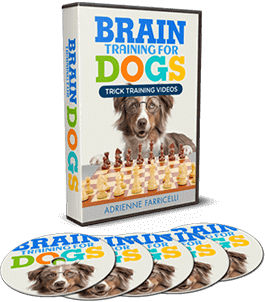
Bite inhibition also has its own place in Brain Training for Dogs, inside an entire section on puppy training that covers potty training, crate training and socialization too, alongside more than 21 brain games for the hours between naps.
What not to do
The same consistency runs through the rest of the basics in the 30-day plan.
- Do not hold the mouth shut, tap the nose or scruff. It teaches hand-shyness and makes handling harder for life.
- Do not use loud corrections with a soft puppy; you will get a dog who freezes instead of one who learns.
- Do not let the game restart within a second of a hard bite — the pause is the whole lesson.
- Do not encourage hand-wrestling and then punish mouthing. Pick one rule and keep it.
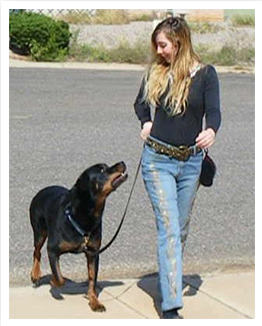
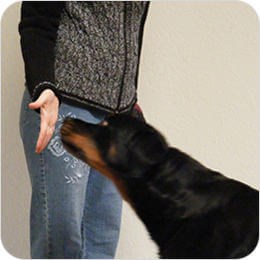
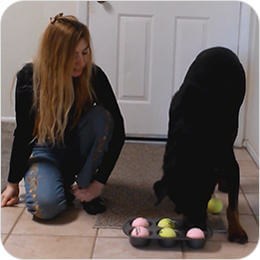
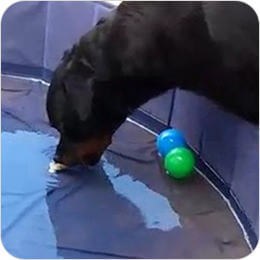
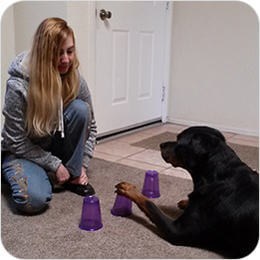
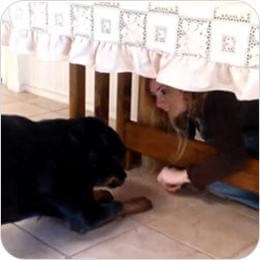
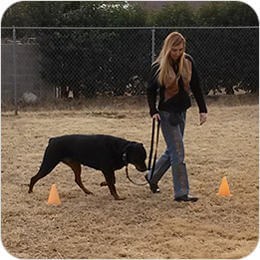
A look inside Brain Training for Dogs







FAQ
At what age does puppy biting stop?
Mouthing usually fades between four and six months as the adult teeth come in, sooner with consistent bite-inhibition work.
My puppy bites harder when I yelp. What now?
Some puppies find the yelp exciting. Drop it and use the silent version: hands away, stand up, ten seconds of nothing.
Is it aggression?
Play biting in a puppy is normal development. Stiff body, hard stare, growling over food or resources is a different conversation — that is where a certified trainer earns their fee.
What about biting ankles and trousers?
Stop moving, because movement is the reward. Then redirect to a toy and, if it is a herding breed, add a daily outlet that uses the chase drive.
Next step
Pick the stage that matches your puppy tonight and hold one rule for a week, everyone in the house the same way. Then add a nap before the evening spike.
Based on standard force-free, positive-reinforcement training practice as taught by certified trainers. Product details for Brain Training for Dogs are from the vendor’s published page as of September 28, 2026.