
Disclosure: this article contains affiliate links. If you buy through them, we may earn a commission at no extra cost to you. How this works.
Short answer
Piano chord inversions are the same chord with a different note on the bottom. C major is C-E-G in root position, E-G-C in first inversion and G-C-E in second inversion — the same three notes, rearranged.
Inversions let your hand move a step or two between chords instead of jumping, which is the secret to smooth, fast chord changes.
Chord inversions and fast changes, step by step
- Interactive ebooks with step-by-step video lessons and 1,000+ audio lessons
- Rhythm style first, then ballads, blues, jazz, ragtime and improvising
- Learn to read music as you learn to play by ear
- Lifetime access on any device and a 60-day money-back guarantee
Root position, first and second inversion
To make an inversion, take the bottom note of a chord and move it to the top. Do it once and you have the first inversion; do it twice and you have the second. A third time brings you back to root position, an octave higher.
| Chord | Root position | 1st inversion | 2nd inversion |
|---|---|---|---|
| C major | C-E-G | E-G-C | G-C-E |
| F major | F-A-C | A-C-F | C-F-A |
| G major | G-B-D | B-D-G | D-G-B |
| A minor | A-C-E | C-E-A | E-A-C |
Why inversions make changes easy
Play C, F and G in root position and your hand leaps up and down the keyboard. Now play C as C-E-G, F as C-F-A and G as B-D-G: the thumb stays on or near C, and only a finger or two moves at each change.
That is the whole idea. Choosing the inversion closest to where your hand already is keeps the music connected and lets you change chords in time, even at speed.
How to find any inversion fast
- Start from the root-position triad you know.
- Move the bottom note up an octave to get the next inversion.
- Learn the look of each shape: root position is evenly stacked, while each inversion has one wider gap — a fourth — and the root sits at the top of that gap.
- Say the chord name, not the inversion name, while you play. The goal is to think C, not second inversion of C.
Slash chords are inversions in disguise
In chord charts, C/E means a C chord with E in the bass — a first inversion — and C/G means G in the bass, a second inversion. Play the note after the slash with the left hand and the chord shape with the right.
Songwriters use slash chords to make the bass walk smoothly: C, C/B, Am, Am/G is a classic descending line.
Give the left hand the root
While the right hand plays inversions, the left hand usually plays the root of each chord an octave or two lower: C under C-E-G, F under C-F-A, G under B-D-G. The bass keeps the harmony clear no matter which inversion is on top, and the two hands together sound full.
Once that feels easy, let the left hand alternate root and fifth — C and G under a C chord — and the accompaniment starts to move.
Seventh chords have four positions
A four-note chord such as G7 (G-B-D-F) has a root position and three inversions: B-D-F-G, D-F-G-B and F-G-B-D. The principle is the same — move the bottom note to the top — and so is the payoff: smooth motion between chords.
A practice routine for inversions
- Play each major chord in C, F and G through all three positions, up and back, hands separately.
- Play the I-IV-V-I progression — C, F, G, C — using the closest inversion each time.
- Move the same progression to a new key each week.
- Accompany a simple song with the right hand in inversions and the left hand on single bass notes. The songs in easy piano songs for beginners are ideal for this.
Where inversions fit
Inversions build directly on the triads in piano chords for beginners. Once they feel natural, every new chord you learn comes with three or four ways to play it, and choosing the right one becomes second nature.
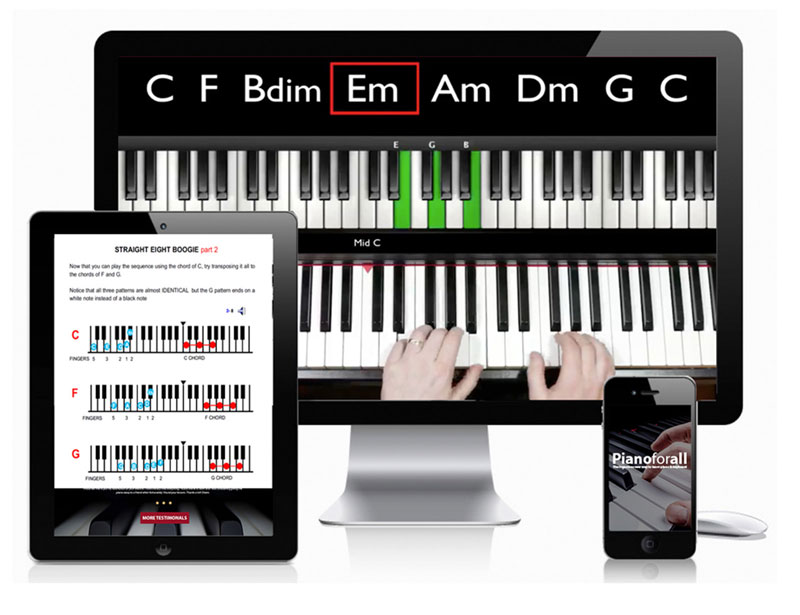
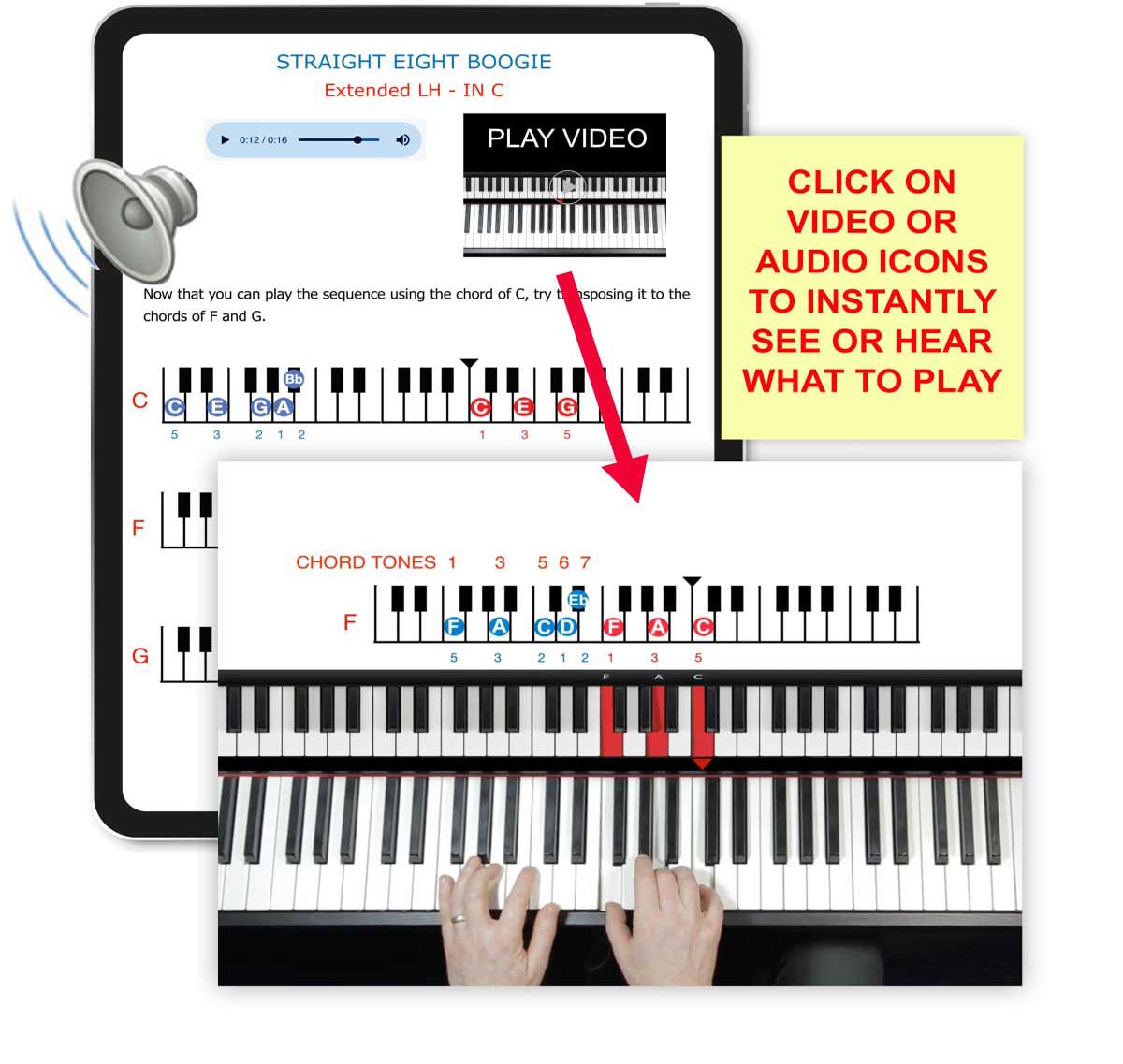
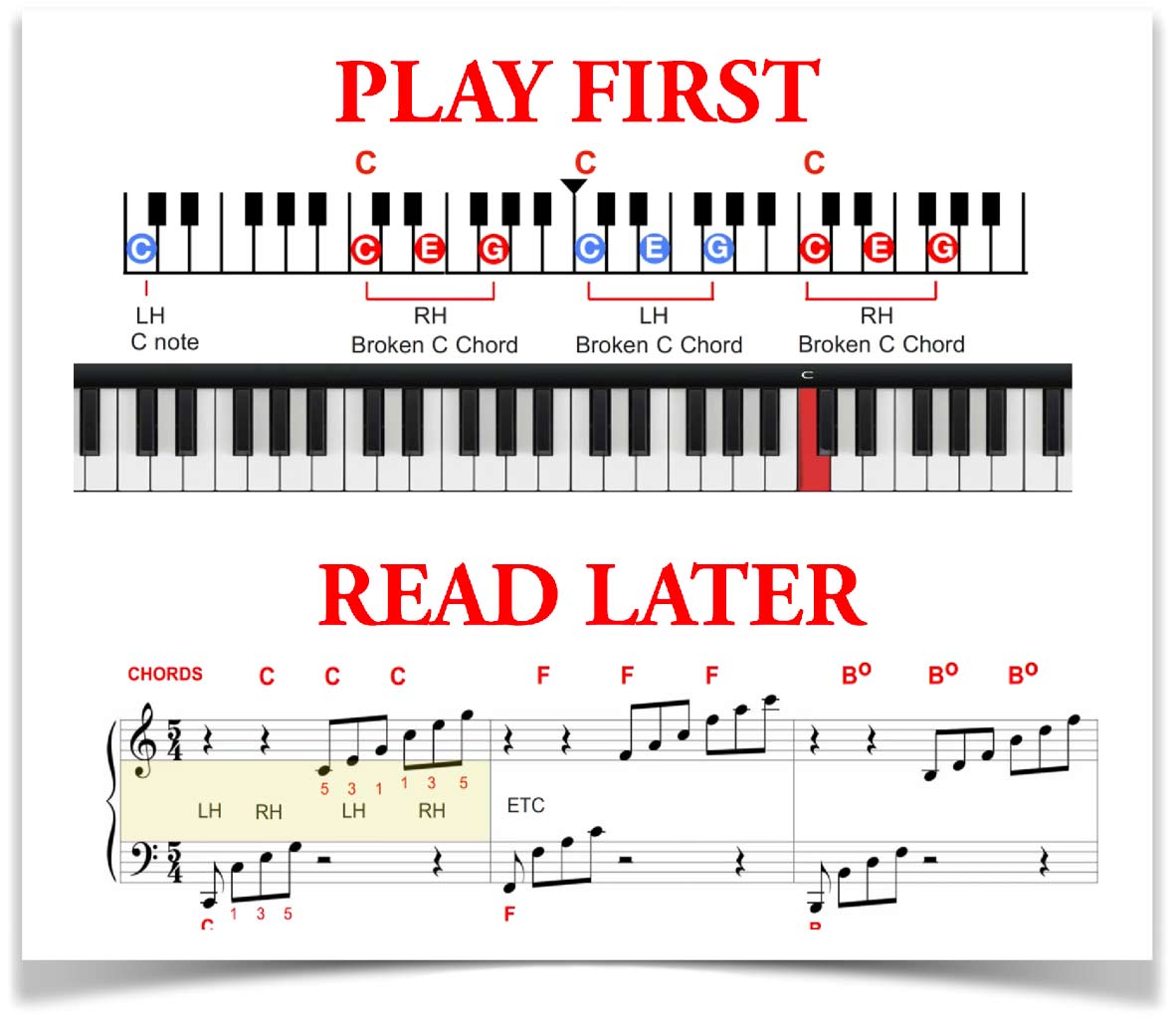
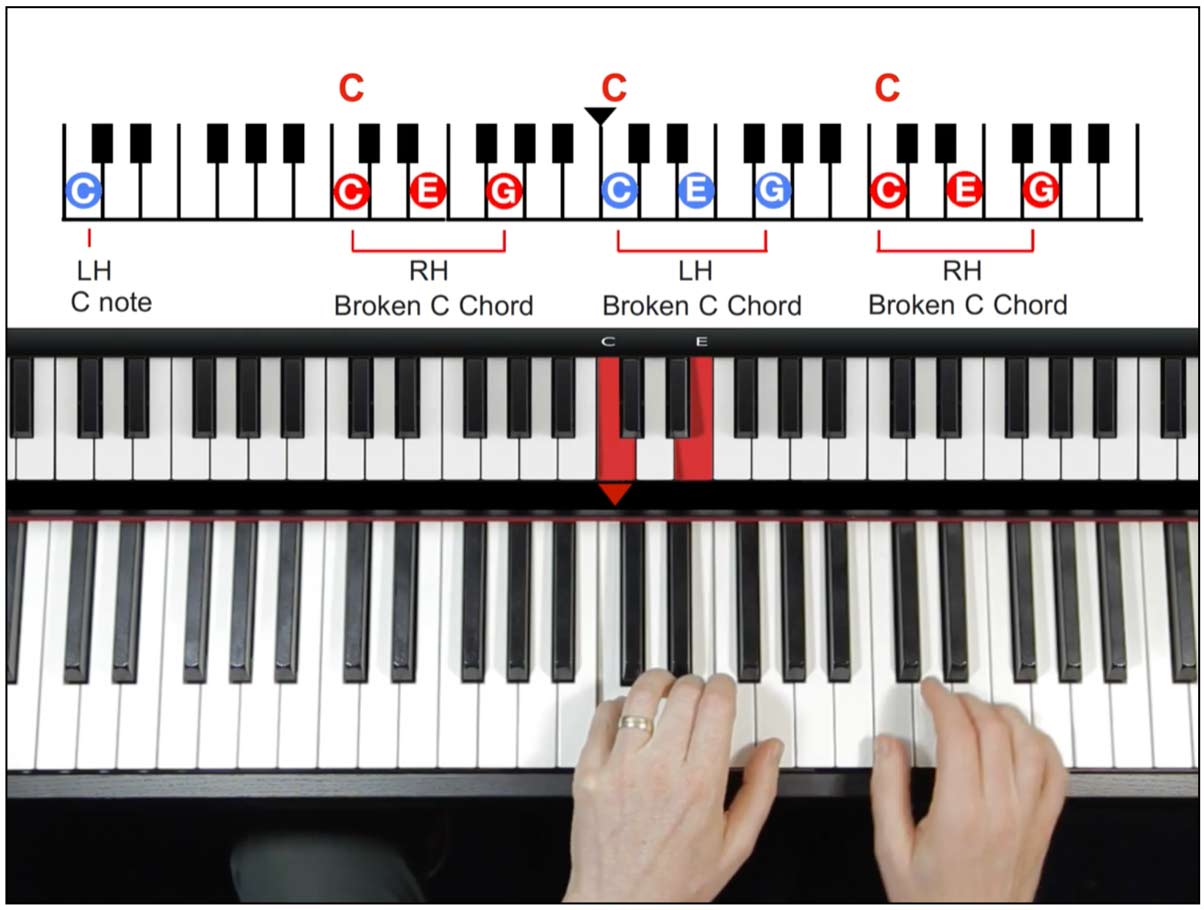
Pianoforall gives inversions a whole book, built to help you change chords at speed, and the course moves step by step from rhythm-style piano into ballads, blues, jazz and ragtime, with video and audio built into its interactive ebooks.
A look inside Pianoforall















FAQ
What is a chord inversion on piano?
The same chord with a different note in the bass. C-E-G, E-G-C and G-C-E are all C major.
Why use chord inversions?
They let your hand move less between chords, which makes changes smoother and faster.
How many inversions does a chord have?
A three-note chord has two inversions plus root position; a four-note seventh chord has three.
What does C/E mean?
A C major chord with E in the bass — the first inversion of C.
Next step
Today, play C-E-G, C-F-A and B-D-G in a loop with your right hand until the change feels effortless.
Based on standard music theory for triads, inversions and slash-chord notation. Product details for Pianoforall are from the vendor’s published sales page as of September 29, 2026.