
Disclosure: this article contains affiliate links. If you buy through them, we may earn a commission at no extra cost to you. How this works.
Short answer
Blues piano for beginners rests on three things: the 12-bar blues chord pattern, a repeating left-hand boogie figure, and the six-note blues scale for the right hand. With those, you are playing recognizable blues within a few practice sessions.
It is also one of the most forgiving styles to learn, because the blues scale sounds good over the whole progression — ideal for a first try at improvising.
Blues and rock ‘n’ roll rhythms, step by step
- Interactive ebooks with step-by-step video lessons and 1,000+ audio lessons
- Rhythm style first, then ballads, blues, jazz, ragtime and improvising
- Learn to read music as you learn to play by ear
- Lifetime access on any device and a 60-day money-back guarantee
The 12-bar blues pattern
Almost every blues follows the same twelve-bar plan built from three chords: the I, IV and V of the key. In C, that is C, F and G — usually played as seventh chords for the bluesy sound.
| Bars | Chords in C |
|---|---|
| 1 to 4 | C7 | C7 | C7 | C7 |
| 5 to 8 | F7 | F7 | C7 | C7 |
| 9 to 12 | G7 | F7 | C7 | C7 |
The left hand: a boogie pattern
The classic beginner pattern walks up and down from the root of each chord: root, fifth, sixth, fifth. Over C, that is C–G–A–G, played in a steady rhythm, then moved up to F (F–C–D–C) and G (G–D–E–D) as the chords change.
Play it with a swing feel: long-short, long-short, like a heartbeat with a limp. Keep the left hand steady before you add anything on top — the groove is what makes it blues.
The right hand: the blues scale
The C blues scale is C, E-flat, F, F-sharp, G, B-flat and back to C. Those notes work over all three chords of a C blues, so you cannot really land on a wrong one.
Start by playing short phrases of three or four notes, leave space between them, and repeat ideas you like. Blues is built on call and response: say something, pause, answer it.
Simple ways to sound bluesy fast
- Slide from a black key into the white key next to it — E-flat to E over a C chord is the classic blues crush.
- Repeat a short riff and let the chords change underneath it.
- End phrases on the root of the key and let them ring.
- Play less. Space is part of the style.
Try it in another key
Once the C blues feels comfortable, move the whole pattern to G: G7, C7 and D7, with the left-hand boogie starting on G and the G blues scale — G, B-flat, C, C-sharp, D, F — on top. Everything you learned moves with it.
Playing the same blues in a second key is the fastest way to prove you understand the pattern rather than just remembering where your fingers go.
Practice routine
- Five minutes of left hand alone, swinging, all twelve bars without stopping.
- Five minutes of the blues scale, up and down, right hand alone.
- Five minutes putting them together: left hand steady, right hand playing only a few notes per bar.
- Finish by improvising freely for a couple of choruses. Record it now and then.
Where blues fits in your learning
The blues uses the same chord shapes as everything else — see piano chords for beginners — and it trains your ear better than almost any other style, which ties into how to play piano by ear.
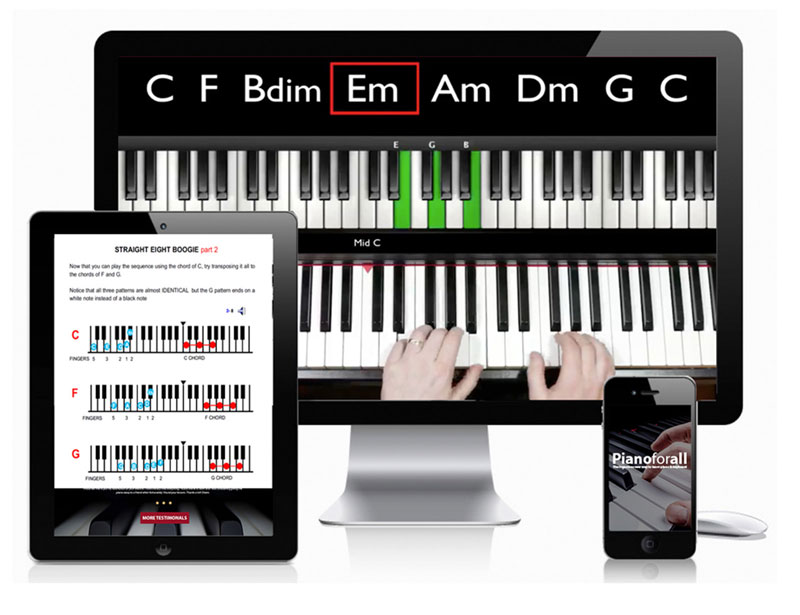
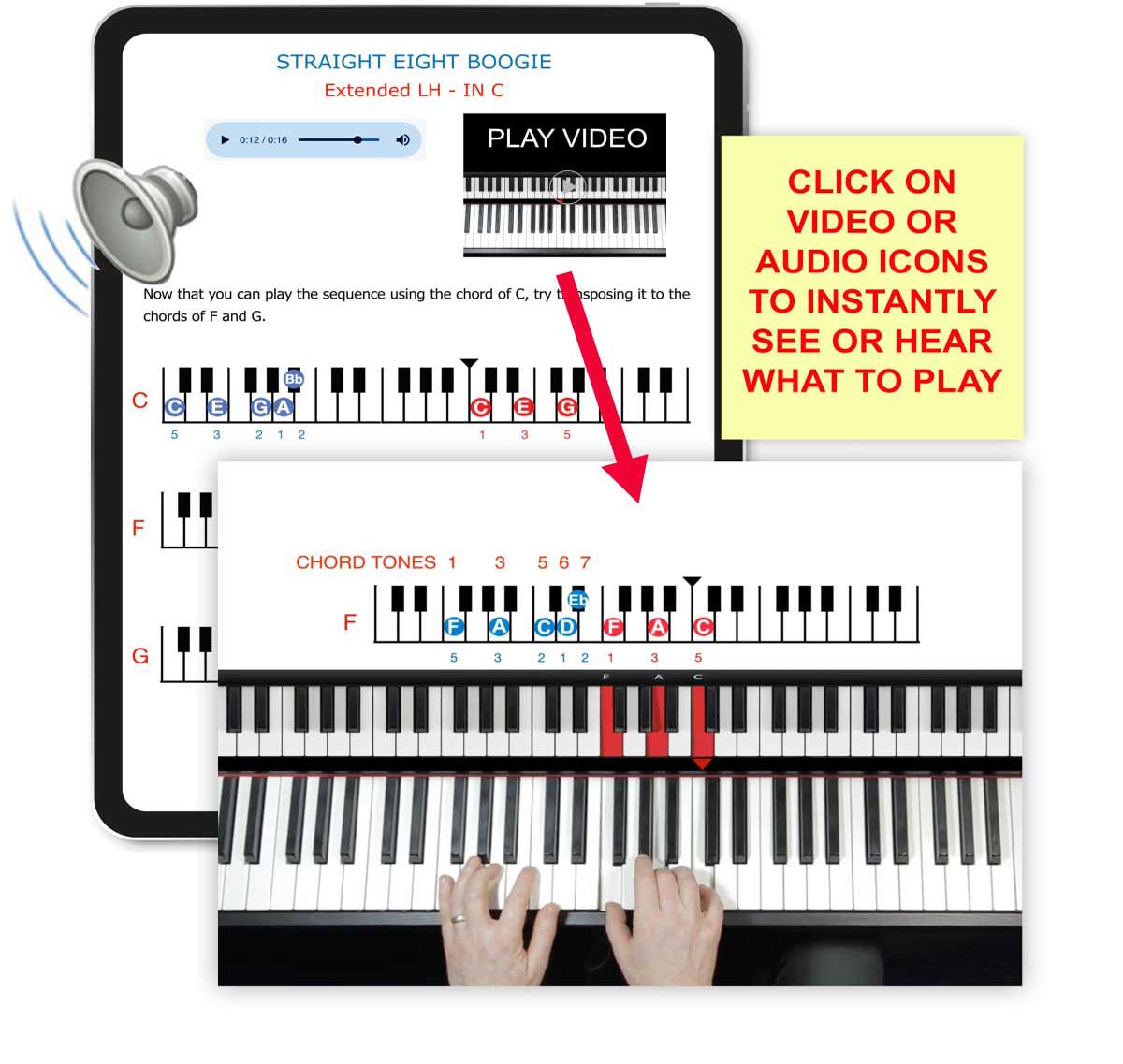
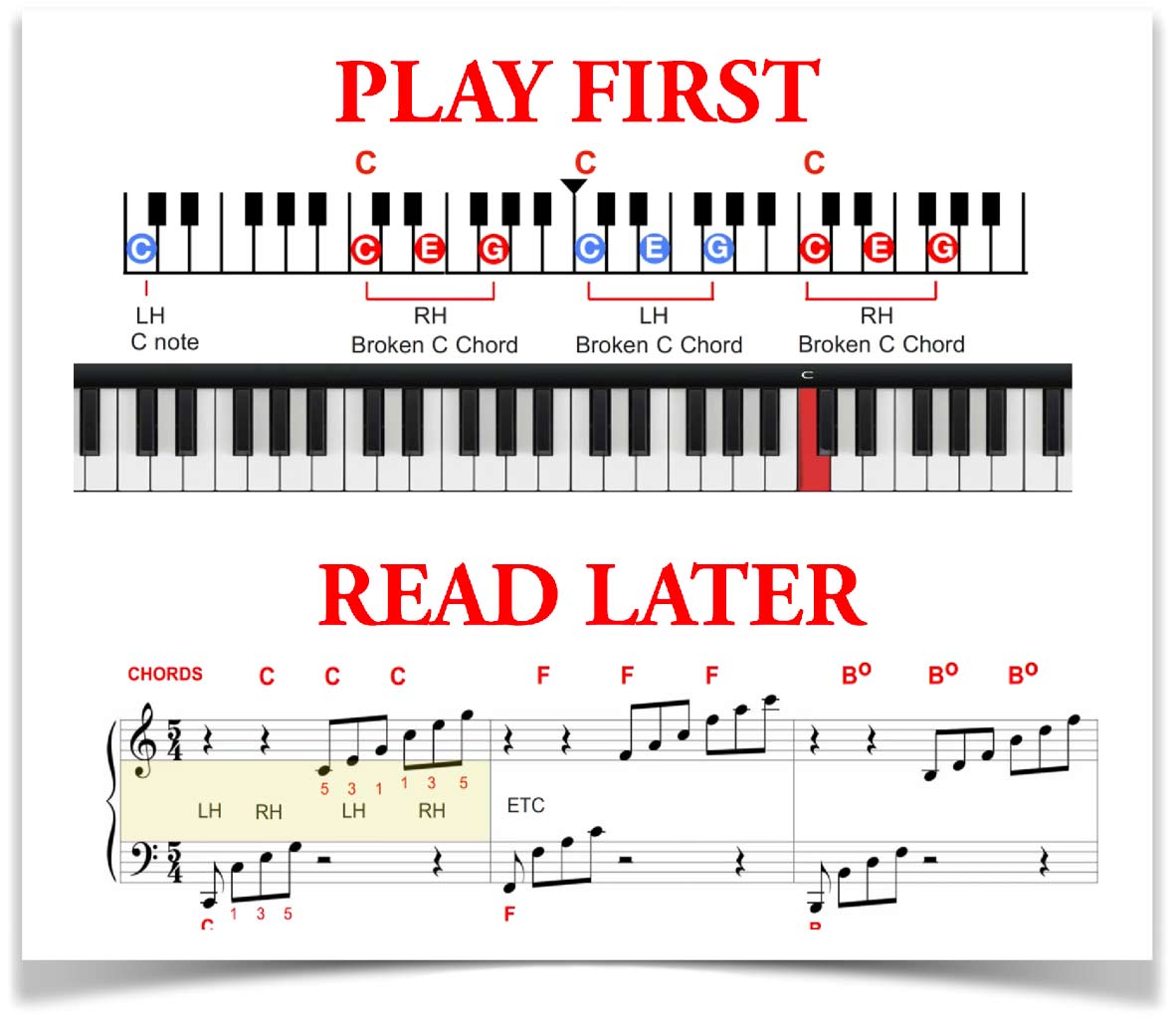
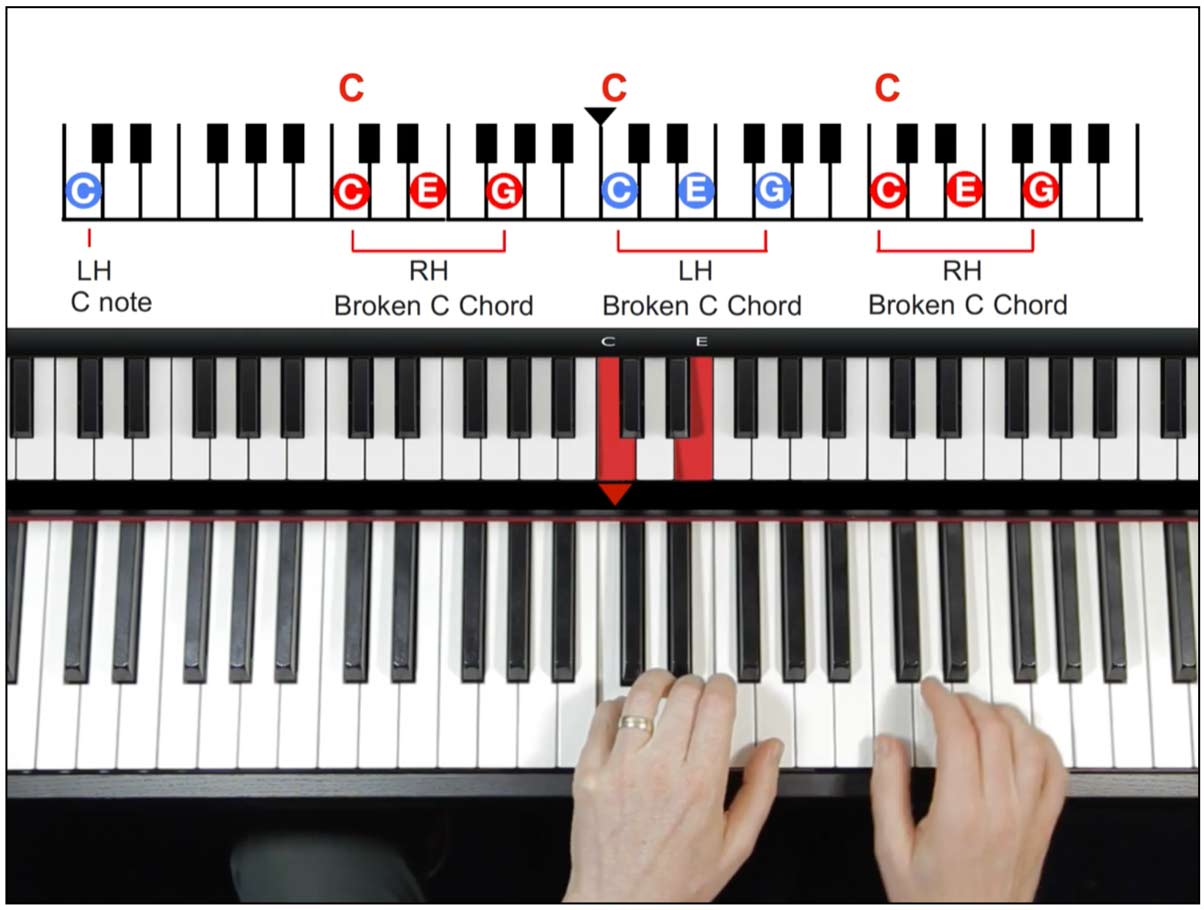
Pianoforall has a whole book on blues and rock’n’roll piano, with the sounds of players like Fats Domino, Jerry Lee Lewis and Little Richard, and it teaches you to improvise over iconic blues rhythms, all with video and audio built into its interactive ebooks.
A look inside Pianoforall
















FAQ
Is blues piano good for beginners?
Very. It uses three chords, a repeating left hand and one scale that works over everything, so beginners make music quickly.
What is the 12-bar blues?
A twelve-bar chord pattern built on the I, IV and V chords of a key. In C: four bars of C, two of F, two of C, then G, F, C, C.
What notes are in the C blues scale?
C, E-flat, F, F-sharp, G, B-flat and C.
How do I start improvising blues on piano?
Keep a steady left hand and play short phrases from the blues scale with the right, leaving space between them. Repeat the ideas you like.
Next step
Tonight, swing the left-hand boogie pattern through all twelve bars in C without stopping. Tomorrow, add three notes of the blues scale on top.
Based on standard blues harmony and piano practice: the 12-bar progression, boogie-woogie bass patterns and the blues scale. Product details for Pianoforall are from the vendor’s published sales page as of September 29, 2026.