Disclosure: this article contains affiliate links. If you buy through them, we may earn a commission at no extra cost to you. How this works.
Short answer
A small workshop layout is decided by two numbers: the longest board you will cut, and the width of the door you carry it through. Everything else follows from those.
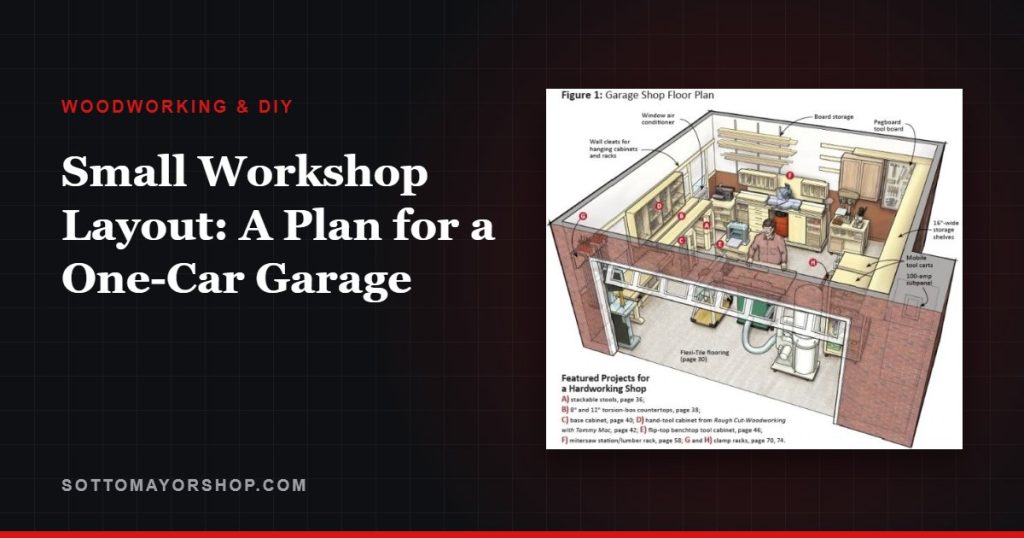
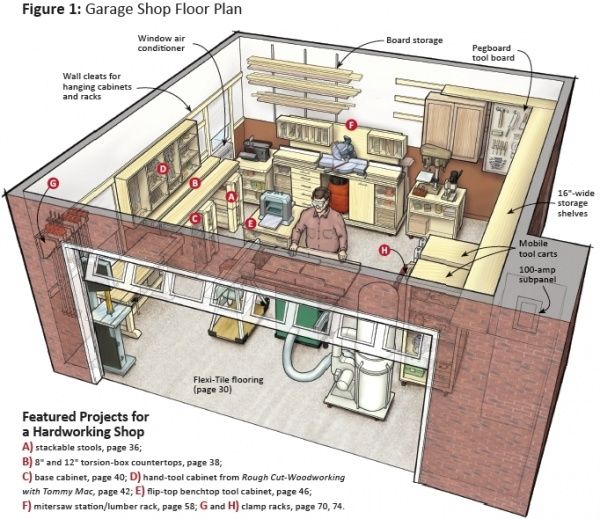
In a one-car garage, plan five zones — bench, cutting, assembly, storage, finishing — and put every machine on wheels so the room can be three different shops in one afternoon.
Floor plans for shops as small as 10 x 6 ft
- 246-page illustrated guide in six modules
- Tool shopping lists for budgets under $500 and under $1,000
- Layouts for spaces as small as 10 x 6 ft, plus lighting, noise and air quality
- Instant access and a 60-day money-back guarantee
Measure two things before you draw anything
The first is the longest stock you will handle. If you break down 8-foot boards, you need roughly 8 feet of clear run on the infeed side of the saw and the same on the outfeed. That is 16 feet of straight line, and in a 20-foot garage it means the saw sits near the middle, not against a wall.
The second is your door. A 30-inch door decides the widest assembled piece that ever leaves the room. People build the cabinet first and discover this second, which is how finished work ends up living in the shop forever.
Write both numbers on the wall. Every layout decision after this is a negotiation with them.
The five zones
Notice that only the bench and the storage are fixed. The other three move, which is what makes a one-car garage workable.
| Zone | What lives there | Space it needs | Where it goes |
|---|---|---|---|
| Bench | Vise, hand tools, layout | 6 × 3 ft plus standing room | Against the long wall, under light |
| Cutting | Table saw or track saw, miter saw | Clear run both sides | Center of the floor, on wheels |
| Assembly | Flat surface, clamps | 4 × 4 ft, walk-around | Middle, doubles as outfeed |
| Storage | Sheet goods, offcuts, hardware | Vertical, near the door | The wall you never work at |
| Finishing | Sanding, stain, spray | Away from dust and sparks | Near the door, for ventilation |
Everything rolls
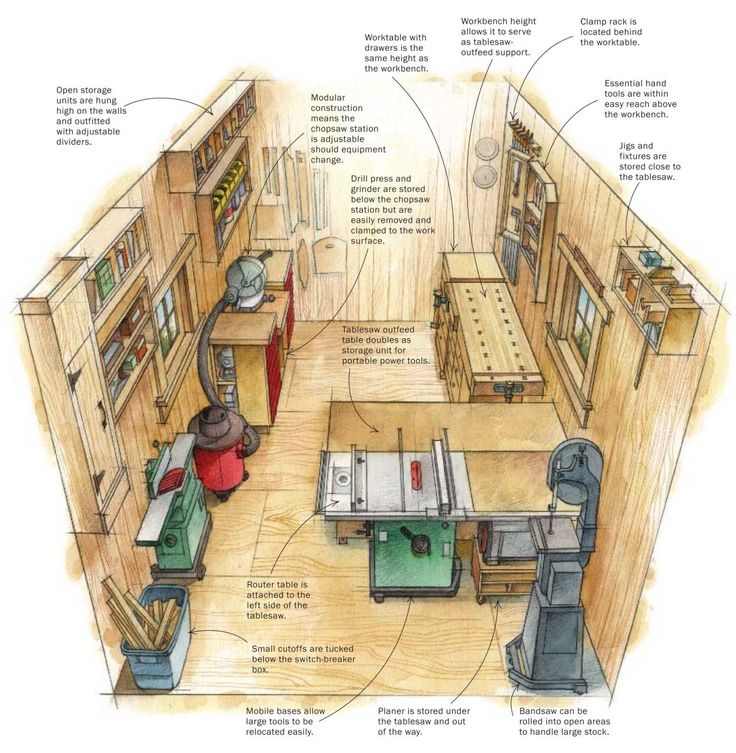
Casters are not a luxury in a small shop; they are the layout. Put locking casters on the saw, the assembly table, the planer stand and the dust collector, and the room reconfigures in two minutes instead of staying compromised all year.
Buy casters rated well above the machine weight and lock all four. A table saw that shifts a sixteenth of an inch mid-cut is worse than one you have to drag.
The bench is the exception. A bench that moves while you plane is not a bench. Keep that one heavy and against a wall.
Work from the ceiling down
Doing it in this order stops the usual outcome, which is a beautiful wall of cabinets and a light bulb hanging behind your head.
- Lights first. Two rows of shop LEDs running the length of the room, not one row down the middle. One row gives you your own shadow over every cut.
- Power second. Outlets every four feet at bench height, plus a ceiling drop over the middle of the floor so the saw is not tethered to a wall.
- Dust third. Even a shop vacuum with a cyclone separator is worth its floor space. Fine dust is the part you cannot sweep up later.
- Storage last. It expands to fill whatever you leave it, so give it the leftovers on purpose.
Clearances that are not negotiable
Around the table saw, keep 3 feet of standing room on the operator side and a clear outfeed path. The outfeed table does not have to be dedicated — the assembly table at the same height solves it, which is why you build that table to match the saw.
At the miter saw, what matters is not depth but length: two wings of support at blade height, 4 feet each side if you can. A miter saw with no wings produces short pieces and long guesses.
At the bench, leave enough behind you to swing a plane stroke or a mallet without hitting the car.
Marking and measuring in a small shop
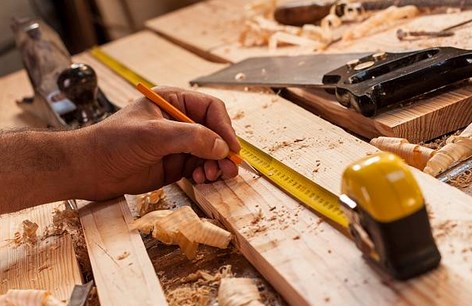
Tight shops punish sloppy layout more than big ones do, because you rarely have room to re-cut from a fresh board. A square you trust, a marking knife instead of a pencil for joinery, and one tape measure used for the whole project are worth more than another machine.
One tape for the whole project matters more than people expect: two tapes from different makers can disagree by a sixteenth over 8 feet, and the error lands in the one joint you cannot fix.
The same discipline runs through reading a cut list without wasting lumber — measure once from a single reference, not cumulatively from each cut.
Build the shop with the shop
The assembly table, the miter saw wings, the clamp rack and the lumber cart are all straightforward builds, and making them is how you learn the machines before you risk a project you care about.
Start with the table, since everything else stacks on it. Our weekend project list has smaller builds if you want a warm-up first, and shed plans with cut lists cover the same idea at a larger scale.
A shop built this way ends up fitted to how you actually work, which no purchased cabinet system manages.
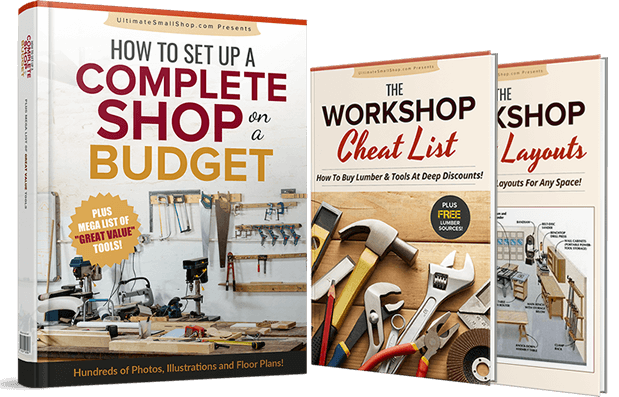
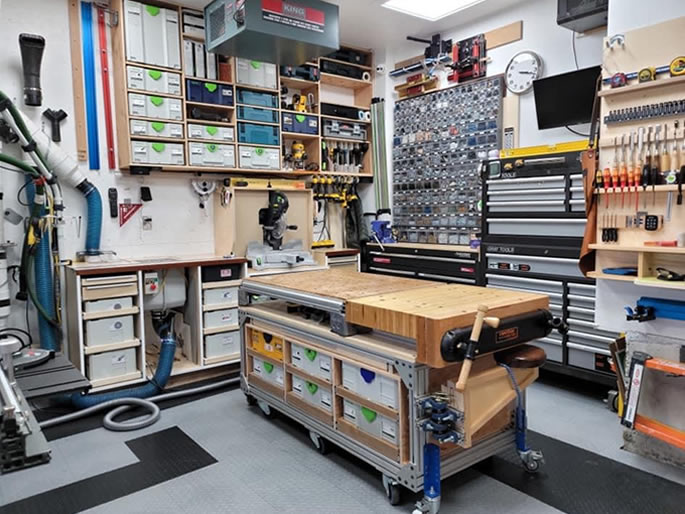
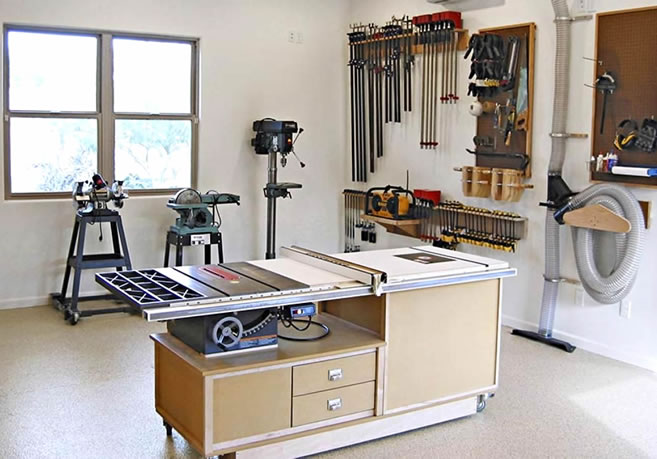
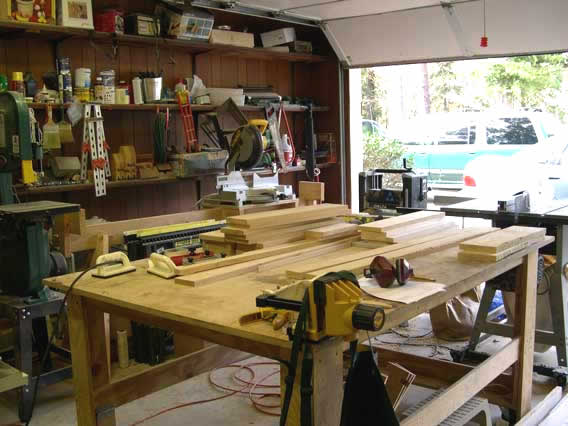
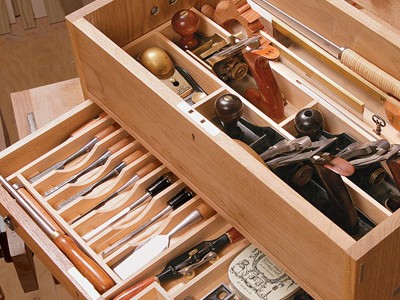
If you would rather follow a complete plan for the whole room, the Ultimate Small Shop guide lays it out in a 246-page illustrated book with six modules: detailed floor plans and space-saving layouts for small spaces, electricity, lighting and soundproofing, and heating, cooling, ventilation and dust.
A look inside Ultimate Small Shop



FAQ
How small can a woodworking shop be?
People do real work in 8 × 10 ft. Below that, the limit is not the tools but breaking down sheet goods, which is solved with a track saw and a sheet of foam on the floor.
Table saw or track saw in a small shop?
A track saw needs no clear run and stores on a hook, so it fits first. A table saw is faster for repeat rips once you have the floor for it.
Do I need dust collection right away?
A shop vacuum with a cyclone separator covers a one-person shop for a long time. The upgrade that matters earlier is a fan and an open door while sanding.
Can I work in a garage that still holds a car?
Yes, if everything rolls and the bench is shallow. Plan the layout for the car being there, not for the weekends when it is not.
Next step
Measure your longest board and your door tonight, write both numbers on the wall, and draw the five zones around them before you buy a single cabinet.
Based on standard shop-layout practice for one-person woodworking shops and on the clearance requirements published in table saw and miter saw owner’s manuals. Product details for the Ultimate Small Shop guide are from the author’s published sales page as of September 28, 2026.