
Disclosure: this article contains affiliate links. If you buy through them, we may earn a commission at no extra cost to you. How this works.
Short answer
Good garage workshop lighting starts with plenty of general light — a common rule of thumb is 50 to 75 lumens per square foot of floor — from LED fixtures at 4000K to 5000K, laid out in rows so light reaches the work from more than one side.
Then add task lighting at the bench and at each machine, and paint the walls and ceiling white. Better light makes every cut, joint and finish easier to get right.
Lighting, power and layout for a small shop
- 246-page illustrated guide in six modules
- Tool shopping lists for budgets under $500 and under $1,000
- Layouts for spaces as small as 10 x 6 ft, plus lighting, noise and air quality
- Instant access and a 60-day money-back guarantee
How much light you need
Lighting guides for garages commonly suggest about 50 to 75 lumens per square foot for general light, and roughly double that where detailed work happens. Multiply the floor area by those figures to get a total, then divide by the output printed on the fixture box to see how many fixtures you need.
| Space | Floor area | General light (lumens) |
|---|---|---|
| Corner shop, 10 x 12 ft | 120 sq ft | About 6,000 to 9,000 |
| One-car garage, 12 x 20 ft | 240 sq ft | About 12,000 to 18,000 |
| Two-car garage, 20 x 20 ft | 400 sq ft | About 20,000 to 30,000 |
Color temperature and color rendering
Color temperature, printed in kelvin, sets how warm or cool the light looks. For a workshop, 4000K to 5000K — neutral to daylight white — keeps the room bright and alert without the blue cast of higher numbers.
Color rendering, the CRI, measures how true colors look under the light. Many shop fixtures sit around 80; look for 90 or higher over the bench or wherever you match stains and finishes, so the color you see in the shop is the color you see in the house.
Lay out the fixtures to kill shadows
- Run fixtures in rows across the whole ceiling rather than one bright light in the middle.
- Put a fixture slightly in front of where you stand at the bench, so your head and shoulders do not shadow the work.
- Light each machine from two directions if you can; a single source throws hard shadows along the cut line.
- Plan the light around the layout: once the bench and machines have their places, as in how to lay out a small garage workshop, the fixtures go where the work happens.
Task lights at the bench and machines
General light gets you around the shop; task light puts the detail on the work. An LED strip under a shelf above the bench, a flexible lamp on a magnetic base at the drill press or bandsaw, and a clamp light you can move where you need it cover almost everything.
Keep task lights to the side of the work rather than straight overhead. Low-angle light across a board shows up scratches and glue spots before the finish goes on.
Flicker, cold and dust
- Choose fixtures sold as flicker-free. Flickering light can make a spinning blade or bit look slower than it is.
- LEDs start at full brightness in a cold garage, where old fluorescent tubes struggled to warm up.
- Dust settles on everything, lights included. Enclosed or wipeable fixtures stay bright longer, and good collection at the source keeps the whole shop cleaner — see dust collection for a small shop.
Power and switching
Linkable plug-in LED fixtures can run from one outlet, which makes them easy to add in stages. For hard-wired lights or a new circuit, hire a licensed electrician; a workshop already asks a lot of its circuits.
Put general lights and task lights on separate switches, so you can light the whole room or just the bench.
Make the room work for you
White walls and a white ceiling bounce light back into the room and fill in shadows. Painted pegboard, a light-colored floor coating and uncluttered surfaces all add up to a brighter shop without a single extra fixture.
Plan the whole shop, not just the lights
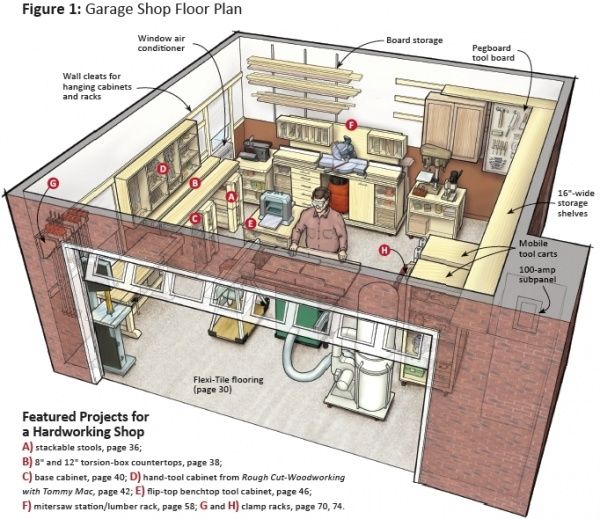
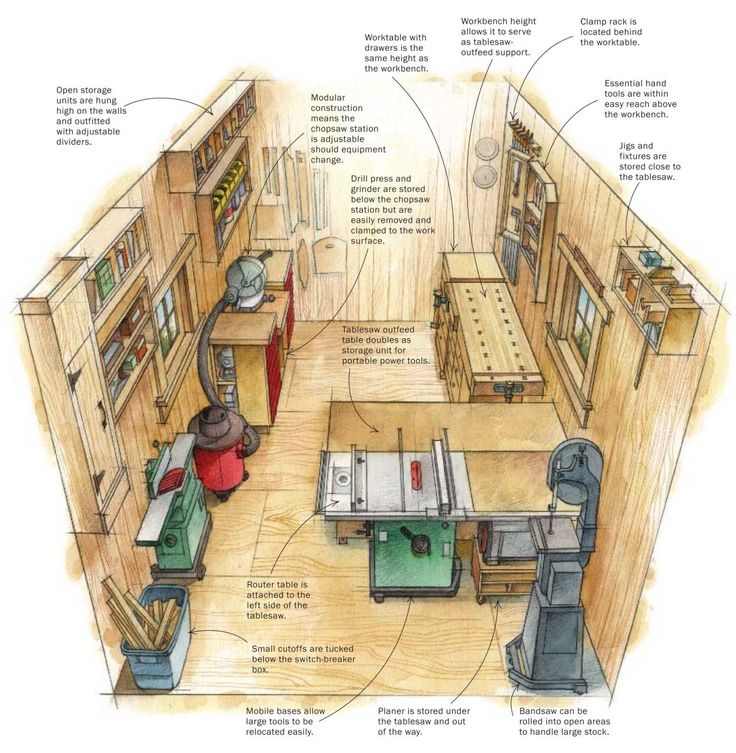
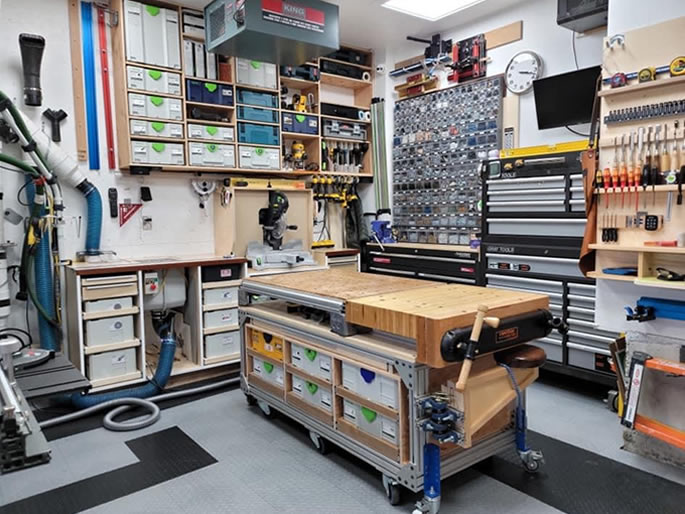
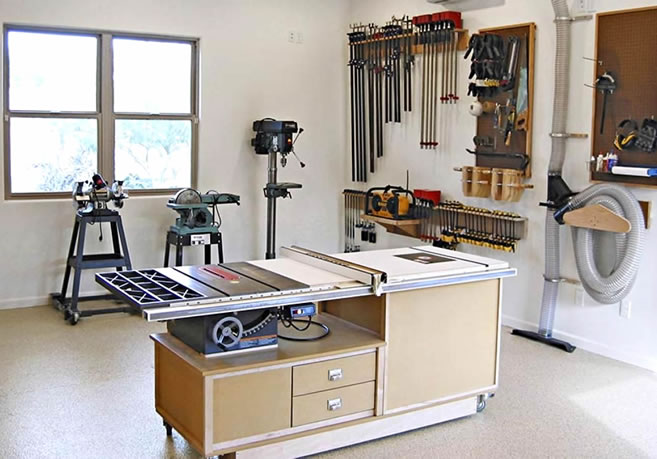
Lighting is one of the upgrades most small shops leave for last. The Ultimate Small Shop guide gives it a place in the plan: its 246-page illustrated book has six modules, including one on electricity, lighting and soundproofing with a worked whole-shop lighting solution, alongside floor plans for small spaces and a module on heating, cooling, ventilation and dust.
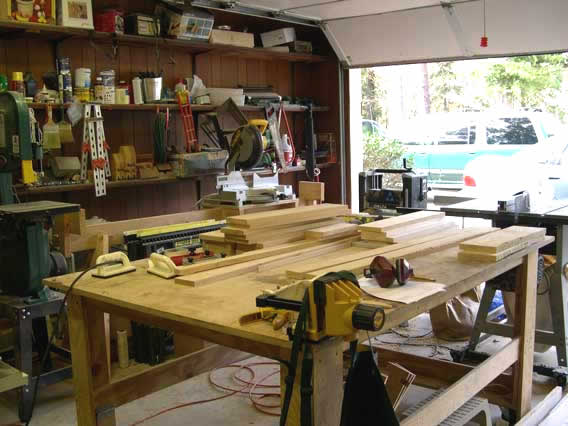
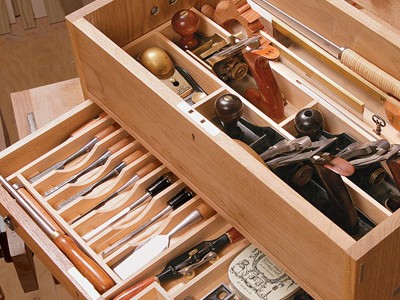
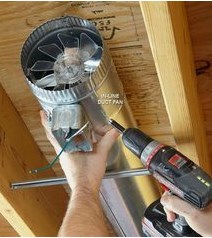
A look inside Ultimate Small Shop









FAQ
How many lumens do I need for a garage workshop?
A common rule of thumb is 50 to 75 lumens per square foot for general light, and about double at the bench.
What color temperature is best for a workshop?
4000K to 5000K, neutral to daylight white, suits most shops.
Are LED shop lights good in a cold garage?
Yes. LEDs start at full brightness in the cold, unlike older fluorescent tubes.
What CRI should workshop lights have?
Around 80 is fine for general light; choose 90 or higher where you judge color, such as the finishing area.
Next step
Measure your shop floor tonight and multiply the square feet by 50 and by 75: that is the lumen range to aim for.
Based on common lighting guidance for garages and workshops: lumens per square foot, color temperature, color rendering and fixture layout. Product details for Ultimate Small Shop are from the author’s published sales page as of September 28, 2026.